



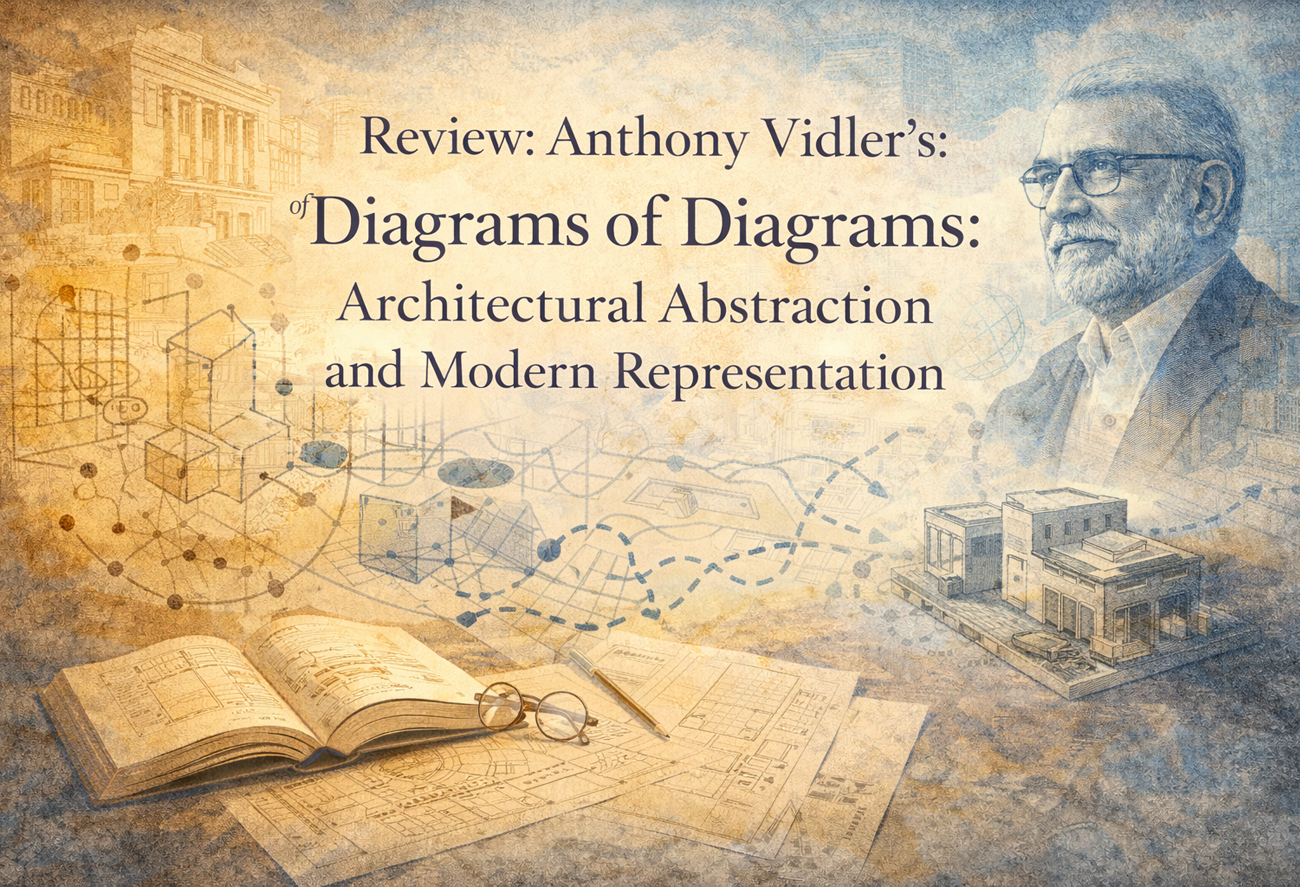
Review: Anthony Vidler’s: “Diagrams of Diagrams: Architectural Abstraction and Modern Representation”
Anthony Vidler’s “Diagrams of Diagrams: Architectural Abstraction and Modern Representation” critiques the modern and contemporary tendency to reduce the diagram to an autonomous artifact. For Vidler, diagrams once functioned as tools that bound representation to building, translating geometry into material form, but in the twentieth and twenty-first centuries they risk becoming hermetic codes, intelligible only to architects and critics. This is a persuasive diagnosis, particularly when one looks at the dazzling but often opaque abstractions of Zaha Hadid, Rem Koolhaas, or Joshua Prince-Ramus. Yet his critique also risks obscuring the longer lineage in which diagrams operated as shared artistic and material languages. A fuller understanding requires weaving together this deep history with the rupture he identified.
From the beginning of Western architecture, diagrams were inseparable from art and construction. In ancient Greece, proportional schemes underpinned the Parthenon, expressing harmonic ratios that joined architecture to music, mathematics, and sculpture. Roman builders, in turn, used diagrams to project vast geometries into built form, as seen in the Pantheon’s perfect circle and dome. Vitruvius codified these practices, insisting that the architect be equally versed in theory and craft, with diagrams serving as the medium that united the two. These were not abstract exercises but instruments for making, legible to builders and patrons alike.
Medieval Gothic construction techniques continued this continuity. Tracing floors and stereotomic diagrams were inscribed directly into stone or plaster to guide vaults and tracery. Architects here were master masons, working side by side with trades, ensuring that diagrams flowed seamlessly into the carving of stone and the erection of walls. The diagram was both an operative tool and a symbolic image, legible to clergy and patrons as patterns of divine order in geometry and light. The Renaissance amplified this communicative power. Alberti and Palladio published diagrams of proportion, perspective, and typology that circulated not only among architects but also among patrons and scholars. A Palladian villa plan, for instance, was a diagram that simultaneously conveyed theoretical ideals and practical instructions, bridging conception and construction.
Even in the Enlightenment and nineteenth century, diagrams were prized for clarity and transmission. Jean-Nicolas-Louis Durand’s graph-paper method at the École Polytechnique distilled architecture into points, lines, and planes meant to be universally comprehensible. The École des Beaux-Arts sustained this communicative function through the esquisse and charrette, training students to produce diagrams that were propositions for both juries and the public. Across these periods, the diagram was not an esoteric code but a cultural instrument, all at once being artistic, communicative, and operative.
The modern rupture began when diagrams shed this broader function and became prized instead for abstraction. Le Corbusier’s épure and Mies van der Rohe’s ethereal planes exemplify a shift toward purity, reducing the diagram to an intellectual construct meant to distill essence rather than communicate intent. By mid-century, figures like Peter Eisenman or Bernard Tschumi extended this trajectory, producing diagrams that were rigorous but increasingly opaque to those outside the discipline. Where Palladio’s drawings could orient a patron and Gothic tracings could guide a mason, modernist and postmodernist diagrams spoke primarily to insiders. Vidler’s critique is clear here: the diagram’s communicative and material roles were eroded in favor of autonomy, creating a gap between architecture’s representational practices and its lived experience.
This estrangement has only intensified in the contemporary era. Digital diagrams—fluid sketches, layered maps, parametric flows—can be dazzling in their abstraction, but they are often interpretable only by those trained within the profession. Clients, laypersons, and even contractors are rarely invited into their meaning. The once-shared language of geometry and proportion has become a professional shorthand, appreciated by those in the know but opaque to everyone else. In this sense, the “art form” of the diagram has been severed from the art of the built environment. It no longer communicates architectural intent across the chain of patron, builder, and inhabitant, but remains largely within the echo chamber of the discipline.
The rupture is not only formal but also professional. Historically, architects were embedded in the act of building. The same master mason who drew a vault tracing might also carve the stone its made of, and even in the Renaissance, architects regularly supervised construction on site and participated in the construction process. By contrast, today’s architects are often distanced from construction due to concerns of liability, litigation, and specializations. Construction management, project planning, and contract oversight have been spun off into parallel industries. The architect’s role has narrowed to design and documentation, while execution is left to managers, contractors, and often consultants. In this fractured system, the diagram becomes an artifact of delegation rather than an extension of the architect’s hand in physical making. The detachment of the profession from the site reinforces the diagram’s detachment from material reality.
Taken together, these shifts explain Vidler’s sense of rupture: diagrams are abstracted beyond public comprehension and detached from the act of building itself. But to treat this as the final word is to ignore the historical record. For centuries, diagrams served as bridges between art and construction, between idea and object, between architect and layperson. They were never merely codes but instruments of imagination and collaboration. The real challenge is not to abandon the diagram but to reclaim its historical richness.
To do so requires architects to restore legibility and engagement. Diagrams must once again be drawn not only for the critic or the discipline but also for the client, the builder, and the community. They should be understood as cultural artifacts capable of inspiring and instructing, not merely as internal codes. Reconnecting diagrams to their material lineage also means reasserting the architect’s presence in making—whether through closer collaboration with trades, design-build models, or renewed responsibility for construction oversight. By reclaiming these roles, the diagram can regain its function as both art and tool.
Vidler’s critique is thus best read as a warning rather than a eulogy. The risk is real: the diagram can collapse into opacity, becoming an instrument of exclusion. But history offers abundant evidence that diagrams need not be so. From the harmonic ratios of the Greeks to the tracing floors of the Gothic, from Palladio’s treatises to the Beaux-Arts charrettes, diagrams have always been capable of uniting conception and realization, art and craft, imagination and matter. The task of the present is not to lament their abstraction but to reforge their continuity. Properly reclaimed, the diagram can once again serve as what it has always been at its best: a bridge between idea and form, art and building, theory and life.
No Comments
Sorry, the comment form is closed at this time.