



Review: Foreign Office Architects (FOA): The Yokohama International Passenger Terminal
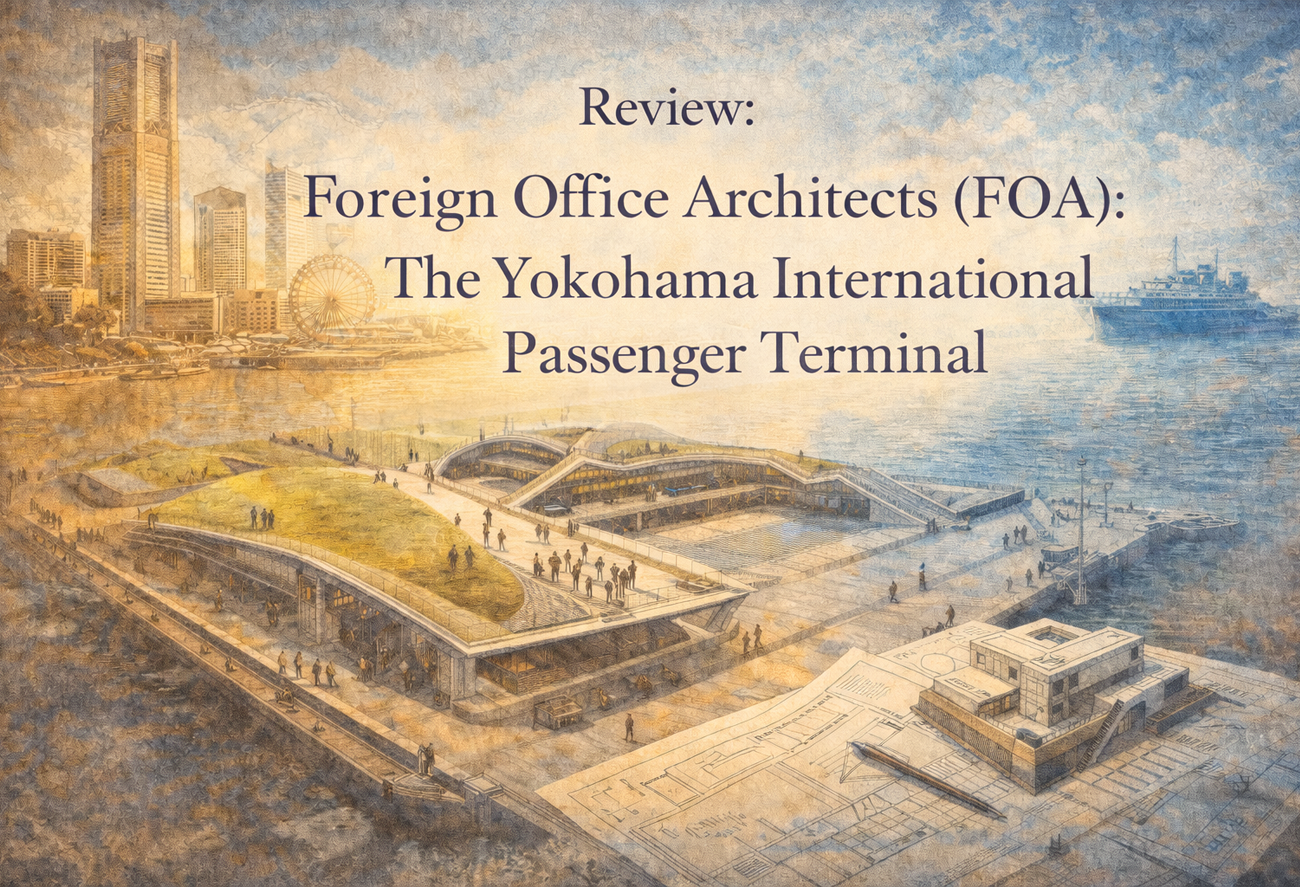
The Yokohama International Passenger Terminal, designed by Foreign Office Architects (FOA) in the 1990s, has come to represent a critical moment in architectural discourse at the turn of the millennium. More than simply a building, it was conceived as a new type of public infrastructure that blurred distinctions between urbanism, architecture, and landscape. As the project evolved, FOA rejected conventional notions of terminal buildings as rigid, circulation-driven structures, instead proposing a dynamic field condition where movement, public space, and architectural form intertwined (Foreign Office Architects, 1995–2002). This bold departure was not only formal but cultural, situating the Yokohama project within global conversations about digital design, postmodern urbanism, and the shifting role of architecture in an era of international exchange.
From its inception, the Yokohama terminal challenged the boundaries between architecture and the city. Rather than treating the terminal as a singular object, FOA conceptualized it as a folded landscape, one that extended the urban ground plane into a continuous surface of ramps, decks, and spatial flows (Foreign Office Architects, 1995–2002). This gesture redefined the relationship between infrastructure and public space, offering Yokohama not just a transport hub but a civic space. Such a move was emblematic of late-20th-century architectural experimentation, where architects sought to overcome the alienation of modernist functionalism and the nostalgia of postmodern historicism. By privileging continuity, fluidity, and indeterminacy, FOA aligned the project with emerging digital methodologies that treated design as an evolving process rather than a fixed object.
The cultural positioning of Yokohama as a site of exchange magnifies the project’s significance. As Japan’s second-largest city and a historic port of international encounter, Yokohama symbolized both tradition and global modernity. The terminal’s location at the edge of the water foregrounded the notion of threshold—between land and sea, Japan and the world, tradition and innovation. FOA’s design responded to this condition by proposing an architecture that itself embodied hybridity: part terminal, part park, part public square. In this sense, the project echoed Japan’s broader cultural identity in the late 20th century, marked by a negotiation between local heritage and global integration. By reimagining infrastructure as civic landscape, FOA situated Yokohama at the forefront of debates about how cities could remain open, flexible, and inclusive amid rapid globalization.
Architecturally, the Yokohama project demonstrated how diagrammatic and digital techniques could be harnessed not merely for formal experimentation but for social and civic purposes. FOA employed diagrams not as abstract codes intelligible only to the profession but as generative tools for organizing flows of people, vehicles, and views (Vidler, 2000). The resulting building, with its sinuous decks and undulating ramps, was less an object to be viewed than an environment to be inhabited. Unlike the hermetic diagrams critiqued by Vidler in his reflections on contemporary architectural representation, FOA’s diagrams retained a legibility that translated directly into lived experience. The public could walk the ramps, sit on the folded deck, and engage the building as a landscape rather than a monument. In this way, the Yokohama terminal resisted the rupture between diagram and built form, offering instead a reconciliation.
Critically, this approach positioned FOA against both the sterility of late modernist abstraction and the theatricality of postmodern pastiche. Where modernism reduced space to functional neutrality and postmodernism indulged in citation, FOA proposed an architecture grounded in process and performance. The building’s form was inseparable from the movement it facilitated: passengers embarking and disembarking, citizens strolling along the decks, tourists gathering at lookout points. In this sense, the Yokohama terminal embodied a performative urbanism, one in which architecture acted as a script for civic life. This performative dimension places the project in dialogue with Bernard Tschumi’s writings on event and space, but FOA advanced these ideas by translating them into a large-scale infrastructural work, demonstrating that even the most utilitarian programs could become cultural catalysts.
At the same time, the project must be read against the broader context of architectural education and professional practice. As with Vidler’s critique of diagrams, the Yokohama terminal raises questions about the accessibility of architectural representation. FOA’s use of digital diagrams was sophisticated, yet the built result was immediately legible to the public. Unlike the opaque abstractions of some contemporary practices, the Yokohama design communicated directly with laypersons and contractors alike, reasserting architecture’s role as a shared cultural language. In doing so, FOA countered the professional exclusivity that has increasingly alienated architects from clients, builders, and communities. The project thus stands as an argument for a renewed integration of design, construction, and public life.
From my perspective, the Yokohama terminal exemplifies how architecture can navigate the tension between abstraction and experience. Vidler (2000) warns of the danger of diagrams collapsing into hermetic codes, but FOA’s work demonstrates that diagrams can still generate forms that are both innovative and socially resonant. The Yokohama project shows that rupture is not inevitable; with careful design thinking, the diagram can remain a bridge between idea and form, art and building, concept and community. In this light, the project can be understood not as a radical departure from architectural tradition but as a continuation of the lineage that stretches from ancient proportion systems to Gothic tracery to Beaux-Arts pedagogy. Each of these moments used representation to communicate architectural intent, and FOA extended that lineage into the digital age.
The legacy of the Yokohama International Passenger Terminal is therefore twofold. On one hand, it represents a milestone in digital design, proving that computational techniques could yield forms of unprecedented fluidity and complexity. On the other, it stands as a cultural landmark, reminding architects that even the most advanced diagrams must ultimately be in service of public life. Its decks, ramps, and open spaces remain not just feats of engineering but invitations to civic participation. For architectural education, the project continues to serve as a model of how theory, technology, and public engagement can converge. For practice, it suggests that the architect’s role is not simply to produce dazzling images or complex codes but to shape environments that are at once innovative and inclusive.
In conclusion, the Yokohama terminal is more than an infrastructural node; it is a cultural statement about the possibilities of architecture at the turn of the 21st century. FOA’s design transcended the limitations of both modernist abstraction and postmodern citation, offering instead a model of architecture as civic landscape. By reintegrating the diagram into lived experience, the project resisted the rupture Vidler describes and demonstrated the enduring potential of architectural representation as art, communication, and construction. As such, the Yokohama terminal remains a touchstone for understanding how architecture can engage with globalization, technology, and civic identity without losing its connection to the public it serves.
No Comments
Sorry, the comment form is closed at this time.