




Material Under Pressure: A Comparative Analysis of Soils and Concrete Testing in California Civilian Construction and Military Combat Engineering
Abstract
This essay provides a comparative analysis of soils and concrete material testing between civilian construction projects located in California and military construction projects located in combat zones, such as Iraq. It explores how the civilian and military construction sectors each approach materials testing based on differing performance expectations, regulatory requirements, and operational priorities. Civilian construction is guided by strict standards from building codes to regulatory bodies such as the American Society for Testing and Materials (ASTM) and the American Concrete Institute (ACI). The focus of this test is on long-term durability, sustainability, cost-effectiveness, and environmental resistance which in turn creates a built environment that lasts generations. Military construction, particularly that carried about by the United States Army’s Technical Engineering Specialists (12T), prioritizes rapid deployment, adaptability to different environments, heavy equipment loads, resilience to extreme conditions, and environmental extremes not commonly seen during civilian construction projects. This essay also explains the differences in the testing equipment, concrete types, and highlights how military protocols accommodate field limitations and urgent mission requirements. Key findings will illustrate that while both sectors rely on a similar foundation of knowledge for material testing of soils and concrete, their testing standards and methodologies reflect the fundamentally different goals of each. This comparison offers insights into the diverse and often demanding world of military construction scenarios in which this author has personal experience.
Material Analysis of Soils and Concrete:
Comparing Civilian and Military Construction Testing Protocols
In both civilian and military construction environments, the integrity of a structure relies entirely on its foundation. That foundation, made up of soils and concrete in most construction scenarios, requires a knowledge of material science to appropriately assess soils and concrete for construction purposes. As urban development continues to accelerate and global defense operations expand into ever-increasing environmental extremes, a comparison of materials analysis becomes a focus to understanding the strategic differences in methodologies across both sectors.
Civilian construction projects in California, ranging from residential to infrastructure typically, prioritize costs, sustainability, and regulatory compliance. As a result of regulatory mandates at the federal, state, and local levels, soils and concrete testing has standardized procedures. These procedures and protocols are generally overseen by organizations such as the American Society for Testing and Materials (ASTM) and the American Concrete Institute (ACI). However, these tests and protocols are done in predictable, laboratory-controlled environments where performance metrics can be aligned to regional codes, and long-term maintenance can be planned since there is a heavy emphasis on the long-term usage of the material.
In contrast, military construction in combat scenarios is significantly more complex. With demands for rapid deployment and completion of construction of projects in abbreviated time windows, the resilience of those projects to not just extreme environmental conditions but also direct and indirect fire scenarios, which can include blast conditions, and sustainability concerns in remote to completely isolated tactical zones. Unlike civilian construction projects where individuals are licensed and have higher education requirements, the United States Army relies heavily upon the Technical Engineering Specialists (12T) to not only supervise construction sites but also to test construction materials. One of their main focuses during the 15 weeks of training is on soils and concrete testing. They are trained to conduct this advanced testing in combat scenarios where expensive and often bulky field equipment will not be available, and laboratory settings which can be controlled do not exist. Their work, while having less education than a civilian construction professional, ensures the construction of mission-critical infrastructure, which often includes load-bearing analysis, contamination assessments, and blast resistance evaluations using field deployable equipment, and specialized protocols which would not be standard for civilian construction projects. The procedures themselves were designed especially to account for unpredictable environmental stressors and combat related risks.
This essay looks to investigate the distinct difference between civilian and military materials testing for soils and concrete. Highlighting testing protocols, goals, and performance expectations which may differ between both sectors, even while having some similarities. By exploring these two sectors in tandem we might gain valuable insight into methodologies which serve fundamentally different mission goals but yet they share the end goal of life and safety.
Overview of Materials
Soil Types Found in Construction
The effectiveness and durability of a construction project are heavily dependent upon the type of soil found on the site. In both California and Iraq, the geologically diverse soils pose unique challenges for construction projects during the foundation design phase of the project. California exhibits a broad range of soil types due to seismic activity and varying climate regions throughout; Iraq, however, is generally seen as a singular climate region with desert soil types throughout it, only occasionally being interrupted by ancient river systems such as the Tigres River. Development of construction projects in both regions requires an understanding of the regional differences in the soils.
California
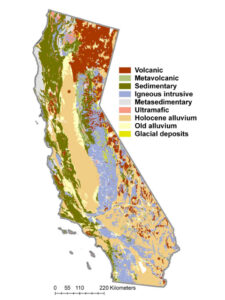
In California, the varying regions have different soils conditions. Common soils types include but are not limited to clay, sand, loam, and silt. Clay is the most common type of soil found throughout the state, which in construction projects is a concern due to its tendency to swell and have poor drainage qualities during wet seasons, as well as shrinking and cracking during dry seasons, causing significant changes which undermines the foundation of infrastructure built upon it. Meanwhile, in more coastal and desert regions, sandy soil lacks cohesive properties to support heavy infrastructure needs without substantial compaction and stabilization. Near mountainous regions and some rivers found in the Northern parts of the state, alluvium soil types create challenges related to poor bearing capacities and settlement issues of infrastructure, which have to be addressed through foundational reinforcements. (Valencia & Lancaster, 2022)
Iraq
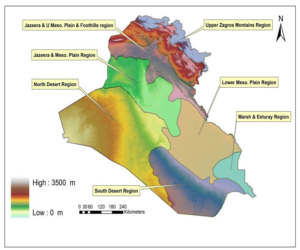
Iraq has a vastly different soils profile comparatively, with its soil being mainly comprised of sands, silts, clays, and gypsum-rich calcareous material. Central and Southern Iraq, predominately near the Tigris and Euphrates rivers, have a soil composition that is alluvial but unlike California it has a higher-than-normal salinity and extremely poor drainage. In some desert areas like that in Anbar province, loose aeolian sand is dominant, making foundation stability difficult without difficult modifications to the soil. Iraq also has a higher-than-normal water table, making many areas unstable for infrastructure without adequate foundation adjustments. These issues with the soils foundational qualities and complexities only compound when military construction scenarios are taking place where rapid deployment, limited testing, and often situational combat constraints are at play. Oftentimes, construction for the military is made complex or less sustainable for long-term uses. (Muhaimeed et al., 2014)
Soil Properties
Soil properties that must be assessed during foundational design phases include, but are not limited to, compaction, shear strength, permeability, and load-bearing capacities. Since California is a seismic risk, with large fault lines running nearly all over the state, this adds another layer of evaluation which requires that the soil on construction sites be evaluated for liquefaction potential during earthquakes and landslide prone areas (California Department of Conservation, The California Seismic Hazards Program). An additional concern in California in the clay and silt type soils is the loss of strength earthquakes (Blanchette & Péloquin, 2016), creating potentially dangerous issues in urban areas with high-density construction due to the fatigue that the earthquakes can have on the soil. In Iraq, which is comprised of mostly loose fine sands, seismic is a minor concern, but there is a large concern due to shear strength, collapsibility, and compression of the soil (Al-Taie & al-Shakarchi, 2017). The results create a hazard to both the structural integrity of military infrastructure and military personnel operating in the environment.
Understanding soils and their responses to environmental conditions and mechanical stressors is important not just in civilian construction projects but also in military construction projects. And while civilian soils analysis is generally done in a laboratory setting with regulatory oversight, long planning phases, and resources that the military does not have access to in the field. However, military projects which have a high demand for flexibility, speed, and resilience in the harshest environments have valuable lessons which benefit the civilian world. The military’s ability to perform in the field under such operational stresses can inform emergency civilian deployment, while the civilian capabilities of laboratory analysis can improve military infrastructure’s long-term useability and prevent potential safety hazards from arising pertaining to soils.
Concrete Types Found in Construction
Concrete serves as an essential construction material, both in civilian and military settings, due to its strength, versatility, and adaptability. The specific formulations used between construction projects in California vs. those in the military settings of the Middle East may vary, but the primary components of cement, aggregate, and water remain consistent across both sectors. The differences in the concrete formulations are determined based upon environmental conditions, costs, performance requirements, and potential logistic issues.
Concrete Types
Typical concrete types found in construction projects in California are Portland cement concrete (PCC), rapid strength concrete (RSC), ordinary concrete, reinforced concrete, precast concrete, and ready-mix concrete, as well as provisions within the California building code 2019 for the use of glass fiber-reinforced concrete and even flat wall insulating concrete form (ICF) systems (California Building Code, 2019). Each type of concrete used in a construction project within the state is chosen based on a number of factors such as seismic requirements, structural requirements, aesthetics, etc. Typically, reinforced concrete is used in commercial and residential structures, pre-stressed concrete (PCC, PSC, RCC) is used in infrastructure projects, and high-performance concretes are used in environmental zones. Additives in concrete are not uncommon in California due to seismic and environmental conditions, which aid in the prevention of cracks and other structurally detrimental conditions. Some additives which are commonly found are silica fume, fly ash, and synthetic fibers.
Military concrete construction in places like Iraq is driven by vastly different needs and standards, with primary concerns centering around rapid deployability, structural resilience in extreme conditions (such as blast and impact conditions during direct and indirect fire scenarios), and resilience in extreme climate conditions which can range from extreme heat to flooding. The primary concrete used in nearly all military construction is that of ordinary Portland concrete cement (OPC) with additives to achieve quick setting times, early high strength, and resistance to sulfates from the soil beneath it. Rapid setting concrete is used primarily in airfields and barriers, which are required to be operational within a matter of days or hours and be able to bear the weight of military operational equipment, which is extremely heavy, as well as sometimes having tracked vehicle systems. An alternative which is sometimes seen in combat scenarios for the same applications is the use of calcium sulfoaluminate cements (CSA). Fiber reinforced concrete is commonly seen in areas where there is a high likelihood of explosive impacts, such as T-Wall barriers and other fortification materials, in which the area may take direct fire (RPG or grenade) or indirect fire (rockets or artillery rounds). Additives such as polypropylene and steel fibers replace the need for rebar in temporary situations while adding strength.
Environmental
Environmental considerations within California and Iraq have some overlap, especially in desert regions of California, which see the similar temperature fluctuations throughout the year. High ambient temperatures during the curing process, such as temperatures in excess of 120°F, can accelerate curing and cause thermal cracking. Concretes used in both civilian and military applications often include retardants, which slow the setting times and minimize cracking. And in combat scenarios where water may not be readily available, the military also uses low water to cement ratios and chemical plasticizers to maintain workability while still conserving water.
Cost
The cost of materials is a concern for both civilian construction projects and that of the military. However, the military has a differing approach when it comes to cost and differing reasons for their use of certain concrete materials related to costs. Civilian construction focuses on the long-term usability of a project and reducing the maintenance of materials. While the military focuses on the rapid deployability and survivability of a material, cost is secondary to their goals. Supplementary cementitious materials (SCM) such as fly ash and slag can be added to concretes such as portland cement concrete and ordinary portland cement, which reduce the raw material costs associated with the construction project (Hanson, 2017). Research and development of more cost-effective, and rapidly deployable solutions for concrete are still being done. This includes that of 3D printed concrete techniques and other hybrid type solutions, which require fewer raw materials but still provide the necessary project goals for each sector.
Resilience
The ability of a structure or infrastructure to withstand natural disasters such as earthquakes is a primary concern for construction professionals in California, where earthquakes can reach magnitudes in excess of 7.0 on the Richter scale. Much of California is at high risk for earthquake-related damage, such in the Bay area where more than 3000 structures are noted to have brittle and inflexible foundation systems, which means in the event of a large earthquake the structures would fail (California Legislature, 2024). As a result of research and past lessons learned, California has some of the strictest earthquake codes, not just in the nation but also in the world. Concretes which offer ductility during earthquake events are not only mandatory under the code but are also being used to retrofit existing structures that have a high likelihood of collapse should a large earthquake happen (California Legislature, 2024).
Although forward operating base (FOB) construction projects do not overly concern themselves with being able to withstand earthquakes, they do, however, have to withstand a broader range of ground movements from impacts of projectiles, vibrations from detonations, and fatigue caused by large vehicle movements. Concretes designed to withstand that of blasts are used in many fortifications, which preserve both human life and vital equipment such as T-walls and bunkers. Multiple layers of concrete and additional additives create structures that perform lifesaving functions in combat scenarios. (ARRADOM, TM 5-1300 1990) Military engineering units are tasked with this heavy job of not just building but also calculating and testing in order to achieve mission goals in the area of operations (AO) that they are sent (Department of the Army, FM 3-34 2020).
Advancements in Research
Although there are differences in construction goals and techniques, both sectors of construction benefit from the continued research and development of concretes. Concretes such as ultra-high-performance concrete (UHPC) have shown great strides in applications such as precast concrete piles, seismic retrofitting’s, thin bonded overlays, security, and blast mitigation (Graybeal, 2011). In California, carbon emissions related to global warming are also a large concern, so companies have begun to find new alternative solutions to reduce their carbon footprints while still maintaining the structural integrity of the product that they produce (Lopez, 2022). For the military, the US Army Corp of Engineers Engineer Research and Development Center along with Defense Advanced Research Projects Agency (DARPA) both continue to develop new products alongside their civilian counterparts which extend the life of FOBs and aim to reduce costs or logistical issues in hostile fire areas.
Understanding each type of concrete currently available for constructions projects allows construction professionals and military engineers to find tailored solutions for their projects. For civilian construction in California the focuses on sustainability, costs, long term performance, as well as meeting regulatory requirements and public needs are not so far from a contrast to military construction missions in hostile fire zones which require speed, survivability, and performance in extreme situations. Concrete is a vital building material in both sectors and the continued advancements and capabilities serve not just that of the civilian world but also that of the soldiers, sailors, and airmen deployed into some of the hostile environments on the planet.
Soils Testing
Stability and performance of all structures, whether they are residential or the highways on which citizens travel upon, starts at their foundation. Understanding soils is one of the most primary and fundamental components of a strong and sturdy foundation. Testing of those soils serves many roles from evaluating a sites suitability for construction projects to deciding what types of foundational methods must be used in the construction which will lay upon it. This testing is not just in civilian environments, where factors can be controlled, but also in hostile fire regions of the world where failures can result in loss of life and endanger critical missions. This section explores the difference between that of civilian construction soils testing and the soils testing done by the US Army’s Technical Engineering Specialists. Highlighting the differences and overlaps between both sectors.
Civilian Soils Testing
In the pre-construction phase of construction civilian projects have specific requirements related to the soil under which structures or infrastructure will be placed. The protocol and testing procedures which are used in order to ensure high standards for safety are met are governed by federal, state, and local standards, with additional guidelines coming from organization such as: the American Society for Testing and Materials (ASTM), the American Association of State Highway and Transportation Officials (AASHTO), and the Internation Building Code (IBC) which in California is expanded to include more in-depth regulation pertaining to all form of construction within the state. The standards which are heavily researched and continue to be adjusted based on new information ensure that structures are safe, reliable, and have a uniform construction so that should the worse happen the failure can be identified and remedied for the future.
Testing Types
Some of the most common testing procedures done are those of the California bearing ratio test (CBR), Atterberg limits test, and the proctor compaction test. And while there are many other tests which are completed prior to construction of a project, we will be focusing on these three. Since they provide the most amount of information for a construction project.
The California bearing ratio test (CBR) is a test which is designed to evaluate the strength of soils samples by measuring their resistance to penetration using controlled environments. It is generally used more commonly to assess whether the subgrade soils of roads or pavement projects are suitable (Mintek Team, 2023). This test can be performed both in a laboratory setting and in the field. The regulatory bodies which use this test include ASTM, AASHTO, the US Army Corp of Engineers (USACE), and even the British Standards. These standards have proven the reliability of pavement design for many infrastructure projects throughout the world (Backus, 2020).
The Atterberg limits test is one of many tests which is designed to identify and classify soil types. It tests for three key parameters of the soil such as liquid limit (LL), plastic limit (PL), and plasticity index (PI); which all identify the water content which the soil may have (Mintek Team, 2023). In clay and silt type soils this extremely important to understand to predict the engineering properties of how the soils move from solid to liquid forms (ABG, 2021). This test is performed in a laboratory setting and are not done in the field. Within this test is the Casagrande cup method involves cutting grooves into a soil sample through the middle, dropping the cup multiple times, and seeing how many blows it takes for the two halves to come together again. For the cone penetrometer method, the sample is placed into a cone which is specified angle, length, and mass to determine that moisture content within the soil (ABG, 2021).
Lastly, the proctor compact test is used to determine optimum moisture content (OMC) and maximum dry density (MDD) of soils samples when compacted for construction purposes (Mintek Team, 2023), more specifically it is used to determine the optimal water content at which soil reaches its maximum dry density (GeoTech Data, 2019). The test consists of compacting a soil sample in a standard mold after being air dried, water is then added at 3% to 5% increments, it is then struck 25 times before another layer is added, and repeated. After this is completed, the sample is removed and dried, after which calculation is done to determine the dry weight of the sample and from there the OMC can then be found on the plotted line (GeoTech Data, 2019). There is a version of the test which can be done in the field using a proctor needle which can give a quick estimate of the soils density.
Important Factors
Testing of soil has become frequently more important as construction is done on previously developed sites. These sites have complex histories which can include that of previous wetlands, industrial zones, and locations where cut and fill was used. These sites can have a range of issues from contamination to instability that must be addressed prior construction. Accurate soils testing prevents future foundation issues, especially in the more urban contexts of current construction since the proximity of existing structures and infrastructure are so high; this allow for the potential to mitigate risks and adverse impacts to not just the new site but the surround infrastructure and structures.
Due to it’s geological characteristics, California soils, require intense testing in order identify the most appropriate foundation types that will be used in a construction project. By identifying if the soil on a site is clay, which is known for movement and water retention, deeper footings or drainage strategies may be used to prevent future issues. Poor drainage on a site can lead to issues such as over saturation, reduced bearing capacity resulting in settling issues and structural damage (Coduto, 2001). Based on additional site testing using tests such as percolation or groundwater monitoring determinations of a soils permeability and season water behaviors can be made to prevent damage to structures (Coduto, 2001).
Soils testing also allows for the potential of reusing “native soil” back on a site rather than engineered fills, which can be costly, present logistical issues, and have environmental impacts (Coduto, 2001). Testing includes heavy metals such as lead, asbestos, and other dangerous chemicals or compounds which can impact the health and safety of site users. The safe removal and disposal of hazardous soil is strictly controlled by the EPA and other regulatory bodies within the state of California. In locations like the Boyle Heights neighborhood of Los Angeles, soils testing is a mandatory requirement due to the contamination from nearby industrial facilities.
Construction professionals in the civilian built environment rely upon accurate standardized soils testing to achieve their goals of cost effectiveness, longevity of structures, and safe use for long periods of time by users. While in urban built environments there may be difficulties which differ from those of more rural environments the protocols and testing procedures remain static, ensuring that whether a structure is built in a rural area or an urban one standards are still equal. In the next section we will discuss the distinct procedures and challenges which the military faces when it comes to the foundational material of soils.
Military Soils Testing
Within the military soils testing is completed by military occupational specialties, such as the US Army’s Technical Engineering Specialists (12T), and the protocols are designed to be able to be completed within tactical environments. The unique demands of forward operational construction sites require that materials be rapidly deployable and that the infrastructure that is then built can withstand extreme conditions. Unlike its civilian counterparts there are no extended planning abilities for military construction engineers. Due to this testing is done at accelerated rates, interpretations of results are nearly immediate, and the military engineer must be highly adaptable to changes in scenarios and situations.
Testing Types
Whether it is a civilian construction project or a military one, soils testing must be conducted. For the US Army, which is entirely performed by the Technical Engineering Specialists (12T), whose primary focus is that of construction of not only living and working facilities but also that of airfields and lifesaving fortifications. Testing procedures for soils analysis include rapid classification of soils, CBR testing with dynamic cone penetrometer (DCP), and nuclear density testing.
Military forward parties must be able to identify and classify soils appropriate for military construction rapidly based upon intelligence reports, local individuals, maps and aerial photography (Department of the Army, TM 3-34.43 (FM 5-472) 2015). Access to accurate information for combat locations is not always available so 12T’s must rely upon local nationals who have been in region for long periods of time for information regarding site suitability. These individuals can provide valuable data regarding climate, water sources, quarry potentials for gravel, and other construction necessities. Being able to identify a soil type based on instinct is part of military training, and during the early 2000s soldiers were taught how to test soil using their mouths which although not always accurate was a fun, and very gross, exercise for those involved. However, there was a greater focus placed on visually being able to identify between soil types.
For military airfields and road infrastructure an in-place CBR test with a dynamic cone penetrometer (DCP) is done. This can be used for both unimproved surfaces and improved surfaces which military vehicles and aircrafts travel upon (Department of the Army, TM 3-34.43 (FM 5-472) 2015). A conversion from DCP to CBR is required and the conversion chart is provided in a manual specifically from DCP to CBR conversions and uses of DCP. DCP testing is very fast and can be done in field environments in hostile fire zones since it allows military assets to be able to move into forward positions more quickly.
Nuclear density testing is used to determine both dry density and moisture content, and the testing devices come in both nuclear and non-nuclear options. For the US Army most of these devices are nuclear and require specialized inspections and care while in use. The moisture content with these machines is determined by counting the hydrogen atoms in the soil (Department of the Army, TM 3-34.43 (FM 5-472) 2015). These devices however are not designed for spot testing for quality assurance purposes on small scales, they are meant for large scale building projects and are rarely seen in forward operating locations due to the risks involved with their operation (Department of the Army, TM 3-34.43 (FM 5-472) 2015).
Important Factors
In forward operation theatres, such as Iraq, soil types range from very fine sands to clays, which present construction challenges similar to those seen by civilian construction professionals. Although in a forward operating environment there is less time to make decisions on whether a sites soil content will require stabilization. 12T’s also have the tasking of recommending stabilizations such as mechanical reinforcement with aggregates or use of other foundational stabilizers. The methods chosen by the 12T’s are often directly related to the amount of resources, time, and logistical concerns which is why they are required to be so accurate in their field testing.
Compaction concerns related to infrastructure are unique due to heavy equipment loads and track vehicles which traverse the infrastructure regularly. Compaction that has not been done to standard results in a multitude of issues which would negatively impact the military mission in combat scenarios such as settling, collapses, rutting, and even loss of life. The compaction standards which infrastructure requires for military operations generally exceeds that of what civilian engineers require due to the difference in stresses seen (Department of the Army, TM 3-34.43 (FM 5-472) 2015).
Soil contamination from fuel spills and chemical weapons have left substantial residues which comprise soil quality in locations such as Iraq. Soil contamination is not just a threat to military personnel, but it can also corrode foundational supports and reduce stability in foundations. Military engineers are trained to identify the potential of soil contamination and coordinate for possible environmental assessments, in a severe case fill would be used to prevent future issues.
In Iraq’s river area, such are around the Tigris and Euphrates, water tables are higher than other parts and are prone to flooding. Due to the soil type found in those locations the soil may appear stable enough for construction in the dry months, but tests are done to confirm that that remains true in the wet months. Drainage and water management are issues which face not just river areas but also mountainous ones, where flash flooding or sudden rainfall can happen. To control issues of drainage, military engineers use permeability tests and review site grading to ensure that there is proper drainage. In some cases, culverts or the use of elevated pads, which were used throughout FOB Diamondback in Mosul Iraq, are constructed which use minimal equipment and prevent possible failures due to water intrusion.
Military operations in forward operation locations, like Iraq, create unique challenges for military engineers who have to be adaptable and rely upon their training to accomplish their missions. The US military, like on the civilian construction side, uses a number of manuals to ensure that testing is done to standard. These manuals provide valuable information and tools, as well as information for potential adjustments that might need to be made in a field environment. Failures in planning can lead to loss of equipment and lives, not just a loss of structures.
Concrete Testing
Concrete is one of the most universally used building materials in modern day construction projects, from foundations to walls its highly adaptable and ease of use make it an ideal material. Civilian applications require that concrete materials conform to strict regulatory guidelines concerning its stability, seismic resistance, moisture, and environmental impacts. Inversely military application requires that it be rapid setting and have a structural resilience to extreme temperatures and blasts, while also minimizing logistical problems that might arise. The following section examines how concrete is applied and testing in civilian and military construction projects highlighting the differences in goals and performance expectations.
Civilian Concrete Testing
In California, a large number of modern construction projects rely upon concrete products. Concrete is found not just infrastructure projects like the high-speed rail systems or highways but also in residential and commercial developments where its cost savings and ease of use make it a top choice not just in foundations but in other areas within structures. Each project type demands specific concrete types and additives which tailor its uses to whatever the project may call for. Regulatory requirement are guided by the American Concrete Institute (ACI), ASTM, and the International Building Code (IBC) alongside the California Building Code (CBC) ensuring that concrete mixes are both strong, durable, and at a lower cost while still addressing environmental concerns such seismic and thermal conditions. Recent research and recycling capabilities have also integrated the ability of recycled materials to be used to enhance sustainability and reduce the amount of concrete materials being sent to landfills (Silva et al., 2014).
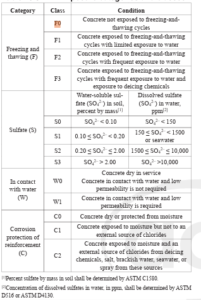
A primary focus for residential construction is that of cost and time, as most projects have a limited budget and short timetables for completion. Concrete used for foundations, driveways, and slab-on-grade applications are typically between 2,500 to 3,000 psi in compressive strength, however for specialized applications designed to withstand seismic events the compressive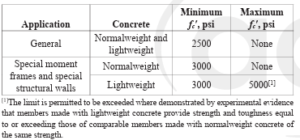 strength requires a minimum value of 5,000 psi (American Concrete Institute, 2014). Another factor in determining concrete for use in residential structures is the structures expose category as determined by ACI-318-14. For most of California there is a limited chance of the concrete being exposed to freezing temperatures, so in place like Los Angeles it’s exposure classification would be listed as F0 but in locations such as Big Bear the classification would be F2 (American Concrete Institute, 2014), due to the fact that the area of Big Bear does experience freezing regularly throughout the year. Admixtures such as those for water reduction and setting time modification, producing flowing concrete, air entrainment, and inhibiting chloride-induced corrosion may be used if necessary, as well as non-approved aggregates and additives which have not been approved but have shown satisfactory performance in the past (American Concrete Institute, 2014). Additional structural support may also be achieved through fiber reinforcements and control joints.
 Commercial structures typically require greater load capacities than that of residential structure, so they require higher strength concrete in their building projects. Since these structures face greater scrutiny due to safety additives such as fly ash, slag cement, and silica fume are added to concretes to resist fluid penetration and improve durability (American Concrete Institute, 2014). Cracking in the slab foundations of these structures can include post-tensioned slab systems, expansion joints, and seismic reinforcements as preventative measures.
Infrastructure such as bridges and highways have even greater regulatory oversight into the materials used during construction. In California, seismicity is of the greatest concern due to the frequency of earthquakes. The concrete used in these projects not only meets high compressive strengths of more than 6,000 psi but also possess ductility and energy dissipation that concrete used in residential or commercial construction do not need (CalTrans, 2019). In California Caltrans specifies that concrete such as rapid strength, precast, self-consolidating (i.e., self-leveling), and lightweight concretes can be used for road work projects with a list of pre-authorized chemical and air-entraining admixtures that can be used (CalTrans, 2019).
Another factor in choosing a concrete type for construction in California is thermal expansion which can lead to cracks in structural foundations. Expansion joints and flexible sealants are used to mitigate thermal expansion due to environmental conditions which may fluctuate throughout the year. Additionally, admixtures are used to manage the curing process which focuses on thermal controls. In infrastructure projects careful analysis is done on environmental conditions to prevent structural deformations and long-term instability due to temperature fluctuations (American Concrete Institute, 2014).
With California moving towards more sustainable building practices, it is not uncommon to find recycled concrete, fly ash, slag, and other construction byproducts being used in construction projects. Using these recycled materials not only reduces the amount of construction materials going into landfills, but it also reduces the carbon emissions necessary in creating concrete materials. Recycled aggregates are recommended by the CalRecycle program to be used as road base, which reduces the need to transport the used material and overall reduces the carbon emissions related to road works (CalRecycle, 2025).
A standard testing method of concrete for civilian construction projects is testing the compressive strength of cylindrical concrete specimens. This test method covers determination of compressive strength of cylindrical concrete specimens such as molded cylinders and drilled cores and it is limited to concrete having a density in excess of 800 kg/m3 [50 lb/ft3] (ASTM, 2023). Performed in a laboratory setting, this test consists of placing an axial load to a molded cylinder of concrete or concrete cores at a rate prescribed in the manual. The compressive strength is then calculated by dividing the maximum load attained by the cross-section area of the specimen (ASTM, 2023).
Another test performed on concrete in California is the slump test which is performed on hydraulic cement concrete. This test is fairly simple and is generally performed in the field. A sample of freshly mixed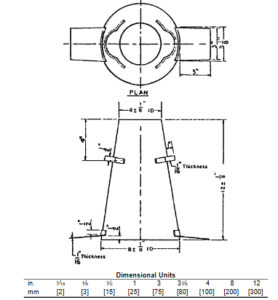 concrete is placed and compacted by rodding in a mold shaped like the frustum of acone. The mold is raised, and the concrete allowed to subside. The vertical distance between the original and displaced position of the center of the top surface of the concrete is measured and reported as the slump of the concrete (ASTM, 2024). This test method is not considered applicable to non-plastic and non-cohesive concrete, so for concretes which have a slump of less than 1/2 in. [15 mm] they may not be adequately plastic and concretes having slumps greater than about 9 in.[230 mm] may not be adequately cohesive for this test to have significance. Caution should be exercised in interpreting such results (ASTM, 2024)
Concrete analysis for civilian project is multifaceted to balance costs, performance, regulatory requirements, and sustainability goals. Each project type, from residential to infrastructure, requires detailed knowledge and thought to find the appropriate types for each use case. Adding to that California is a seismically active region and has variable environments throughout it only adds a layer of attention to detail being necessary. The following section examines the specialized requirements, materials, and testing done during military construction in hostile fire zones, such as Iraq.
Military Concrete Testing
Military construction project in forward areas of operation (AO) face unique challenges which place extreme demands upon construction materials, especially concrete. Due to these demands specific testing and standards have been devised which generally go beyond what is standard for civilian construction applications. Concrete in hazard fire areas must be able to withstand blast forces, heavy dynamic loads, extreme environmental conditions, and seismic activities (in some regions). Standards for testing procedures are guided by the Department of Defense (DoD), and US Army Corp of Engineers (USACE); and are carried out by MOS’s such as the US Army’s Technical Engineering Specialists (12T) who conduct field testing under the most extreme conditions with accuracy.
The availability of concrete materials in combat zones directly impacts the types of materials and admixtures used on projects. Due to a lack of laboratory facilities in most combat AO’s the use of hydraulic type concretes is not generally used. Instead differing types of portland cement are used. An added concern, compared to a civilian environment, is the availability of water. In most cases it is recommended to use potable water (i.e., drinking water), which is where the standards do allow for the use of salt water so long as the foundation materials do not also contain steel or other metals which might corrode. The admixtures used range from water reduction, accelerators, retarders, and air-entraining mixtures (Department of the Army, TM 3-34.43 (FM 5-472) 2015).
A main factor in military construction in forward deployed AO’s is that of blast resistance. In laboratory settings concrete or in the field concretes are tested for dynamic loads and simulated explosions to the concretes ability to absorb and dissipate the energy associated with blasts which are common occurrences in deployment location. Concrete is a primary material is T-walls and military fortifications which prevent the loss of life during direct and indirect fire events throughout a FOB’s time. The ability for a T-Wall to withstand blasts from multiple incoming rockets is imperative to the military’s mission and keeping service members safe. Reinforced concretes, such as those with fiber or steel, prevent explosion induced fragmentation and cracking within the fortifications. (ARRADOM, TM 5-1300 1990)
Another factor in most deployed locations is that of environmental conditions, especially those related to temperature and wind. In locations like Iraq temperatures can reach in excess of 120°F, requiring the concrete be formulated to prevent shrinkage and cracks. This requires that retarding admixtures be used to prevent the concrete from drying too fast during high temperatures and wind events throughout the curing process. In locations like Korea, where temperatures can reach nearly freezing, air-entrainment is used to prevent freeze-thaw damage, as well as adding accelerators to the mixture to ensure that the concrete is still of the proper strength but is able to cure at lower temperatures. (Department of the Army, TM 3-34.43 (FM 5-472) 2015)
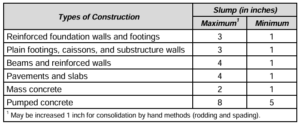 One of the first tests that is completed on construction sites is that of the fresh concrete tests, which include a slump test and air content test. The slump test is performed nearly identically to the one performed by civilian protocols. The difference being what is acceptable limits of the testing results upon completion. Along with the slump test is the air content test which measures the total air and is affected by any air voids in the aggregates. If aggregates have significant air void, corrections must be found so that only the air content measured only reflects the air in the cement.
A nondestructive test that is performed by military engineers is that of the portable seismic pavement analyzer (PSPA) which is a nondestructive device that rapidly measures the physical integrity of concrete and asphalt pavements. The PSPA is dependent upon ultrasound waves which are transmitted into the concrete through the rubber feet under the box. The waves radiate down and out through the concrete from that point, and three receivers capture the reflected waves. This test is generally not performed in hostile fire environments but is seen on occasion within garrison construction projects for quality control purposed by 12T’s. (Department of the Army, TM 3-34.43 (FM 5-472) 2015)
Military concrete testing is again gear towards the preservation of service members lives and performance under extreme conditions, which are for more demanding than what is seen in civilian applications within the United States. Blast resistance and environmental management, as well as the ability to rapidly complete projects make it imperative that the concretes and testing protocols used are versatile, fast, and reliable. In the next section we will discuss the key findings between military and civilian testing of soils and concrete.
Key Findings
This comparative assessment of soils and concrete testing between civilian construction projects and military construction projects shows that both sectors rely upon accurate testing, even while their approaches and standards do not completely align. Civilian construction projects in California are mandated under regulatory bodies and guides focused on preservation of life and safety, durability, and sustainability goals. Military construction in the inverse is focused on rapid deployment, resilience, and adaptability to hostile environments. These differing foci inform not just the testing standards but the types of tests and equipment needs for a given project.
One of the most apparent differences between the sectors is that in soils testing. In civilian projects, laboratories and other controlled testing are used more than those of field tests, as well as having many governing bodies which dictate how the tests are done to what the failures are. These tests prioritize site stability and environmental impacts which can be achieved when the environment is relatively controlled. In military environments the environment cannot be controlled, and field testing must be done rapidly using tools that civilians do not have need for. The technical engineering specialists (which this author was) play the primary role in this testing, ensuring accuracy of the testing despite environmental and operational limits.
The contrast between civilian and military testing is further underscored by concrete analysis between the sectors. Civilian projects, especially those in California, are tailored to a project since materials are readily available and testing can be done as necessary to meet regulatory requirements for strength, seismic, and environmental compliances. Often times recycled materials and admixtures are used to reduce the carbon footprint of the concrete being used in the projects. Military concrete, however, prioritized blast resistance, rapid strength, and the adaptability to extreme environmental situations and mechanical stresses. Material choices in forward operating locations are limited so testing is made further important to be accurate to prevent the loss of life of service members should attacks happen.
Conclusion
Ultimately, this essay illustrates that although both civilian and military construction aim to ensure the health and safety of users, they are governed by different operational needs which shape every aspect of the construction process. Recognizing this difference allows for more effective cross-sector collaborations and the integration of best-known practices to meet the unique challenges presented to both sectors. By integrating these best-known practices from both sectors scenarios such as disaster relief, joint military/civilian facilities, and infrastructure which serves both can be additionally developed to be resilient, efficient, and cost effective which leads to better outcomes during both peacetime and combat missions.
References
ABG. (2021, December 7). Soil properties: Atterberg limits. ABG Geosynthetics. https://abg-geosynthetics.com/technical/soil-properties/atterberg-limits/#:~:text=Atterberg%20limits%20are%20a%20basic%20measure%20of,shrinkage%20limit%2C%20plastic%20limit%2C%20and%20liquid%20limit.
Al-Taie, A., & al-Shakarchi, Y. (2017). Shear strength, collapsibility and compressibility characteristics of compacted Baiji dune soils. Journal of Engineering Science and Technology, 12. https://www.researchgate.net/publication/316629800_Shear_strength_collapsibility_and_compressibility_characteristics_of_compacted_Baiji_dune_soils
American Concrete Institute. (2014). ACI 332-14: Residential Code Requirements for Structural Concrete and Commentary.
ARRADOM. (1990). TM 5-1300. Departments of the Army, the Navy, and the Air Force.
ASTM. (2023). ASTM C39/C39M-21.
ASTM. (2024). ASTM C143.
Backus, B. (2020). California Bearing Ratio Test: CBR Values & Why They matter. GlobalGilson.com. https://www.globalgilson.com/blog/cbr-testing#:~:text=California%20Bearing%20Ratio%20of%20Soil,selecting%20pavement%20and%20base%20thicknesses.
Blanchette, J. D., & Péloquin, E. (2016). CYCLIC SOFTENING AND FAILURE IN SENSITIVE CLAYS AND SILTS. https://www.researchgate.net/publication/304497959_CYCLIC_SOFTENING_AND_FAILURE_IN_SENSITIVE_CLAYS_AND_SILTS
CalRecycle. (2025). Construction and demolition debris recycling. CalRecycle Home Page.
CalTrans. (2019). CalTrans Construction Manual.
California Department of Conservation. (n.d.). The California Seismic Hazards Program. CA Department of Conservation. https://www.conservation.ca.gov/cgs/sh/program#:~:text=Statutes%20require%20that%20cities%20and,of%20buildings%20for%20human%20occupancy.
California Legislature. (2024). Seismic Resilience in California’s Building Stock and Multi-Hazard Mitigation. https://jtemergencymanagement.legislature.ca.gov/sites/jtemergencymanagement.legislature.ca.gov/files/5.14.24%20Seismic%20Resilience%20Joint%20Info%20Hearing%20Final%20Backgrounder.pdf
Chapter 19A concrete: Concrete, california building code 2019 (vol 1 & 2). UpCodes. (2019a). https://up.codes/viewer/california/ibc-2018/chapter/new_19A/concrete#new_19A
Coduto, D. (2001). Foundation Design: Principles and Practices (2nd ed.). Prentice Hall.
Department of the Army. (2015). TM 3-34.43 (FM 5-472).
Department of the Army. (2020). FM 3-34.
GeoTech Data. (2019). Proctor Compaction test. https://www.geotechdata.info/geotest/proctor-compaction-test
GIS and Digital Soil Survey Projects. California Soil Resource Lab. (n.d.). https://casoilresource.lawr.ucdavis.edu/projects/pedology-and-soil-survey/gis-and-digital-soil-survey-projects
Graybeal, B. (2011). Ultra-high performance concrete. FHWA. https://www.fhwa.dot.gov/publications/research/infrastructure/structures/11038/
Hanson, K. (2017). SCMs in Concrete. National Precast Concrete Association. https://precast.org/blog/scms-in-concrete/#:~:text=SCMs%20augment%20cement’s%20actions%20and,slag%20cement%20and%20silica%20fume.
Lopez, N. (2022). Climate-friendly cement? California takes on a high-carbon industry. CalMatters. https://calmatters.org/environment/2022/06/california-cement-carbon-climate/#:~:text=Looking%20to%20the%20future,vice%20president%20of%20corporate%20development.
Martinez, E., Patino, H., & Galindo, R. (2016, November 6). Evaluation of the risk of sudden failure of a cohesive soil subjected to cyclic loading. Soil Dynamics and Earthquake Engineering. https://www.sciencedirect.com/science/article/abs/pii/S0267726116304195
Mintek Team. (2023, November 3). Soil testing for construction. Mintek Resources. https://mintekresources.com/soil-testing-for-construction/#:~:text=California%20Bearing%20Ratio%20(CBR)%20Test,for%20road%20and%20pavement%20construction.
Muhaimeed, A., Saloom, A., Saliem, K., Alani, K., & Muklef, W. (2014). Classification and Distribution of Iraqi Soils. International Journal of Agriculture Innovations and Research, 2(6). https://ijair.org/administrator/components/com_jresearch/files/publications/IJAIR_670_Final.pdf
Physiographic regions of Iraq. | download scientific diagram. (n.d.). https://www.researchgate.net/figure/Physiographic-regions-of-Iraq_fig1_324006202
Silva, R. V., de Brito, J., & Dhir, R. K. (2014). Properties and composition of recycled aggregates from construction and demolition waste suitable for concrete production. Construction and Building Materials, 65(August), 201–217. https://www.sciencedirect.com/science/article/abs/pii/S0950061814004437?via%3Dihub
TM 3-34.43 (FM 5-472) . (2015). . Department of the Army.
Types of concrete. UpCodes. (2019b). https://up.codes/s/types-of-concrete
Valencia, F., & Lancaster, J. (2022). Geology, Soils, and Ecology: How Geology Influences Soil Development and Ecosystems in California.
U.S. Department of Housing and Urban Development. Residential Structural Design Guide (2nd ed.). (2017).
No Comments
Sorry, the comment form is closed at this time.