




Review: Kenneth Frampton: Towards a Critical Regionalism
In Frampton’s writing, he critiques architecture—more specifically, the failings of Modernist architecture and the principles it espouses. He argues that Modernism, in its disregard for culture, nature, and history, has led to the erasure of localized identities; replacing them with structures that adhere to a homogenized and universal aesthetic. Frampton focuses on how architecture can resist the dominant tropes of Modernism, such as the statement “form follows function”, which he believes have had catastrophic consequences. At the same time, he recognizes the value in preserving the elements of Modernism that are effective. Instead of outright rejection, he advocates for a blended approach that restores architecture to a more contextual and rationalistic view; a view in which history, culture, place, and the natural environment work together in a symbiotic relationship.
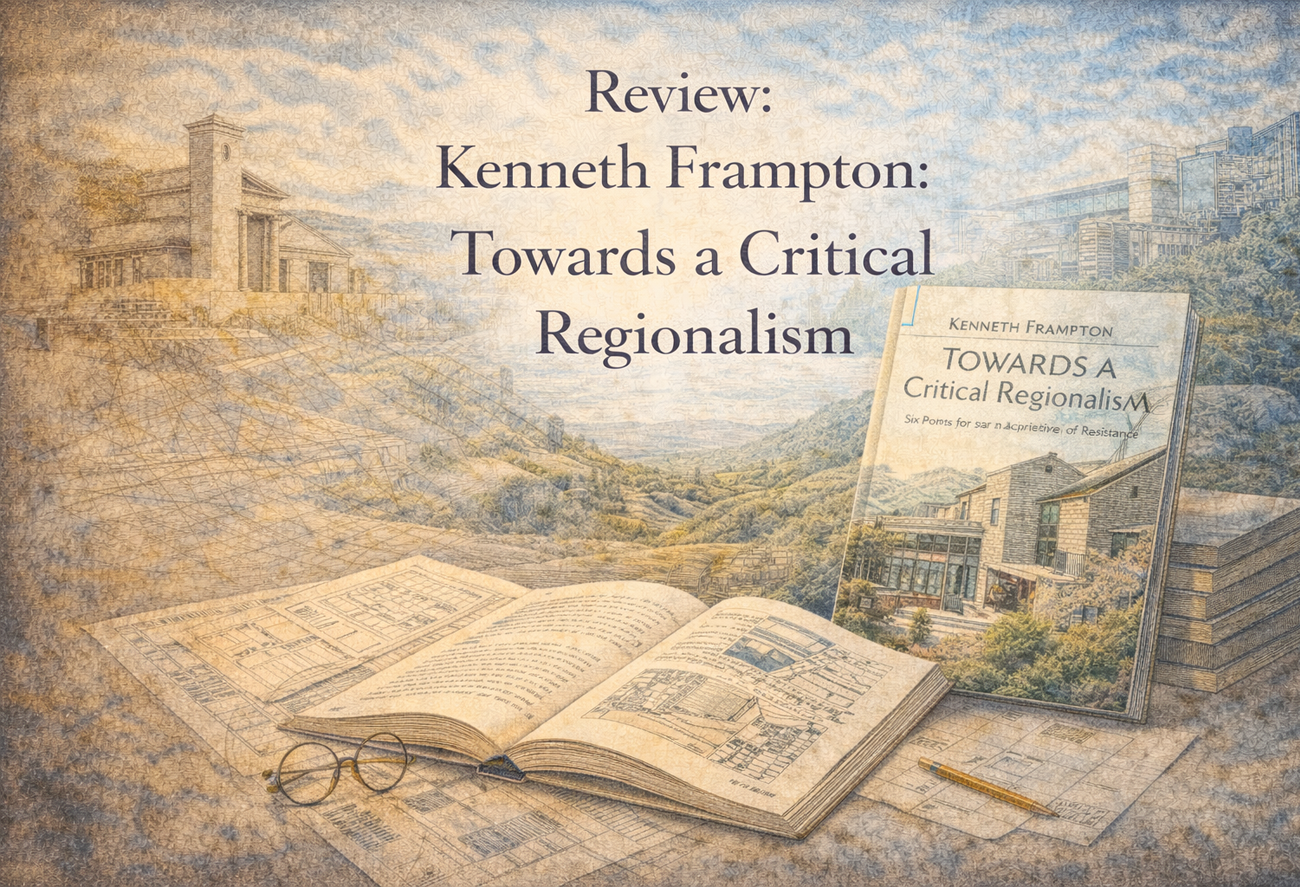
Frampton breaks his philosophy of how architecture should be resisting into 6 categories: culture, critical regionalism, the avant-garde, resistance of the place-form, nature, and visual vs tactile. Throughout he uses examples from not just prominent architects but also philosophers whose opinions on, not just the architectural movements but also society as a whole, are ear marks to a clearer pathway forward. Examples such as Heidegger, who sought to bring about a clearer understanding of
space and place. And Ricoeur at the beginning who said “there is the paradox: how to become modern and return to sources; how to revive an old, dormant civilization and take part in universal civilization” (pg1). In this, Frampton suggests that while Modernists sought to reject and replace what they saw as outdated, they remained unknowingly entangled in the very historical and cultural narratives they attempted to erase. In my view, Frampton is pointing out that history is inescapable—it is etched into human experience, and ignoring it does not free us from its influence, but rather blinds us to the deeper forces shaping our built environment.
And I do not agree with much of his writing, but especially regarding how architecture does not interact appropriately with the natural world. As architects we slap a fancy tags of “sustainable” or “holistic” on projects, especially while we are in school, focusing more on pretty buzz words rather than having any real understanding of what we are doing. Looking from his perspective he is right, we do absolutely disregard topography and other site conditions. Instead opting to create a perfectly level pad, a blank slate if you will, for ourselves to design upon. Except our design doesn’t truly erase what was before, it merely adds a layer of humanistic trash which will be demolished in a decade and replaced with someone else’s “brilliant” idea. But worse we not only demolish the natural world and throw it aside we do so with so little care or thought for those that might come behind us.
Frampton also makes a funny statement, or rather I laughed, of “the main antagonist of rooted culture is the ubiquitous air conditioner”, and he’s not wrong. We spout the buzz words and follow along but even after we’ve exhausted researched, diagrammed, and explained a site analysis not a single design actually accounts for what are known factors. Nope! Instead we again force a design upon the landscape which doesn’t belong, then bring in mechanical methods to create the illusion for the end user that we did all we could to account for nature. All of these issues stem directly from the studio classroom which values Modernist tropes and subjective aesthetics over whether a design is functional.
No Comments
Sorry, the comment form is closed at this time.