




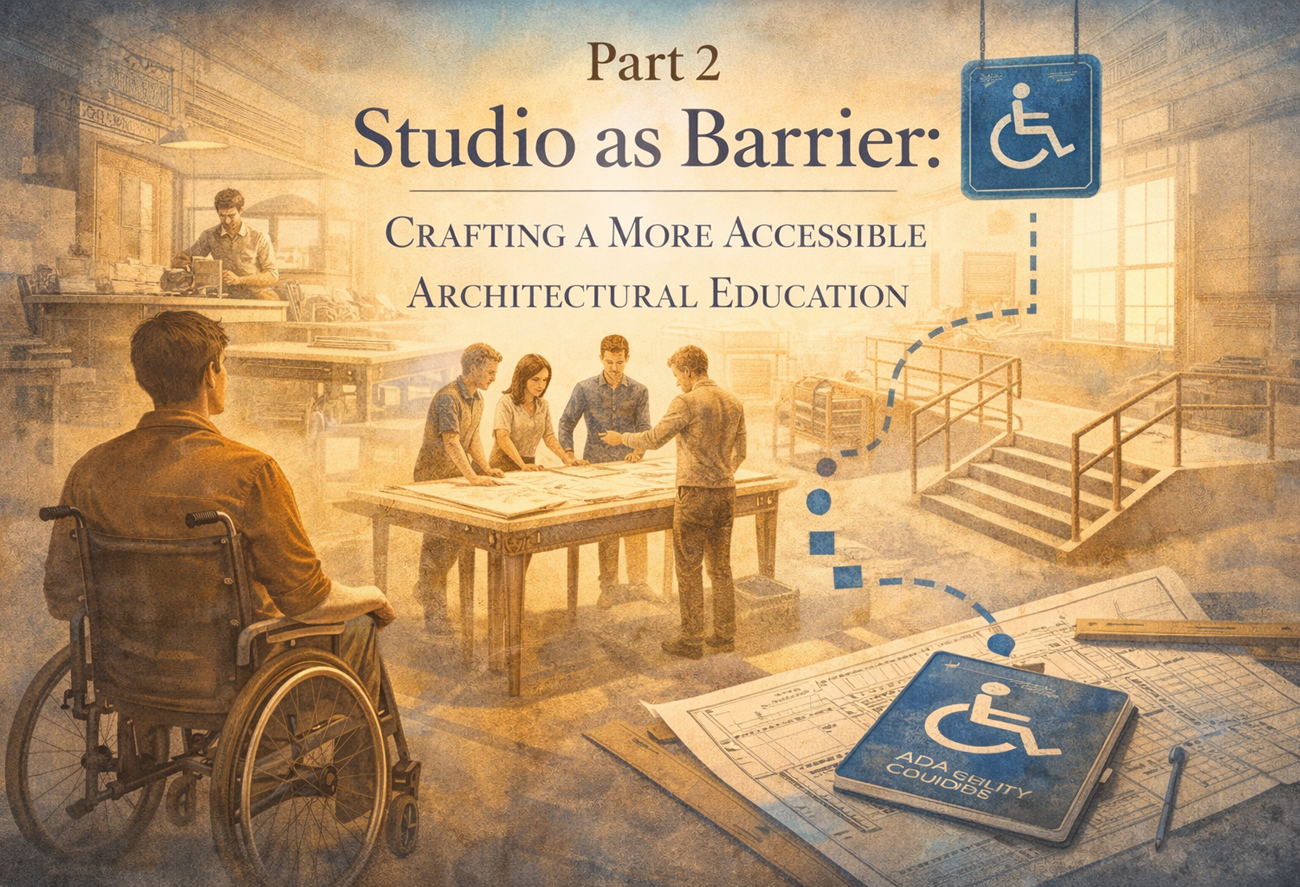
Studio as Barrier: How Architectural Pedagogy Conflicts with ADA Principles (Part 2)
Rethinking Studio Pedagogy:
Inclusive Practices and Pathways Forward
The challenges students face, as outlined in Part 1, illustrates just a small sample of the systemic conflicts between architectural education and ADA principles. The barriers are not insurmountable, since just as architects critically assess and redesign the built environment, so too architectural educators must rethink and innovate the pedagogical approaches used in education. Reimaging the pedagogy moves beyond just being compliant with ADA’s legal requirements for accessibility but rather creates a proactive embrace to diversity.
Inclusive education does not mean static accommodations, such as soundproof pods, or reactive adjustment, such as recording lectures, instead it is an intentional approach to education that attempts anticipate and values the diverse ways that students learn, communicate, and express ideas. Embedding flexibility and empathy into educational design seeks to create a learning environment where every student can thrive. It doesn’t diminish the push for excellence or the challenges in material that students will face, instead it transforms what it means to succeed to better match the diverse nature of the world in which live. Using approaches such as Universal Design Learning (UDL), research based educational frameworks, providing multiple means of engagement, representation and expression ensures that the variability in learning is not a barrier to success.
In architectural education, it is more than just adjusting a turn in deadline or offering alternative formats when deemed feasible by faculty. It demands a complete shift in the culture, especially in how success is defined, how critique is delivered, and how studio spaces are designed. The studio itself must evolve from the one-size-fits-all approach being used today into a dynamic and adaptable learning environment that reflects the professions commitment to equity, accessibility, and human centric design. 1 6
In this section we will cover strategies and models that can guide the transformation to inclusion. These include, but are not limited to, rethinking critique culture, structuring time and workflows, designing sensory friendly spaces, and reframing the role of the educators. Through each intervention the studio environment would better model the values which is touts.
Reimagining Critique Culture
As previously discussed, critique is an engrained mechanism within studio culture. In traditional educational models, critiques are public, high pressure, and extremely performative, where a student stands in front a jury of professionals to present their work. Often times these sessions come with spontaneous questions, ambiguous and often times subjective feedback, and at times that feedback is even hostile in nature [1]. Although it is intended to simulate a professional review process and sharpen the students critical thinking skills, the current traditional format of critiques disproportionately favors students who display extroverted qualities and who can process feedback in real time. For neurodivergent learners this process is not conducive to learning or professional development, rather it is a significant barrier and source of anxiety. 1 2
The reimagining of critique begins with the concept of diversifying feedback methods. Instead of opting for public critiques opt for small groups or private critiques which offer a less intimating setting where students can engage in meaningful dialogue without the performative pressures of the public review process 1. Additionally, offering written and even recorded feedback methods allows students who process information more slowly to facilitate deeper reflection and reduces the cognitive load. Visual feedback tools, such as digital annotations of drawings, can further support the need of many to process the feedback more effectively and gain a deeper understanding of what that feedback was aimed to accomplish.
Another aspect is adding the trauma informed practices into critique. This can involve establishing clear expectations of deliverables, using constructive language, and focusing the critique more on design development rather than passing personal judgements 2. Providing detailed rubrics and guiding questions in advance of the presentation can also reduce anxiety, since there is a reduced expectation of spontaneous deliverables. Making the critique environment more geared around growth rather than the performative evaluation it is today.
Lastly, adding peer led critiques throughout a semester adds value to the critique process, allowing students to engage with their peers work and provide insights prior to professional review. This encourages students to engage is a shared learning opportunity, which not only empowers them but also shifts the dynamic away from judgement from professors and professionals. 22
Diversifying the formats in which critique is done can create an environment that is inclusive, constructive, and more aligned with the diverse needs of the student body as whole. This shift also ensures students who need physical and emotional safety mechanisms to be able to still participate in the learning environment without risking additional symptoms or barriers. It ensures that the learning environment is one that is fostering all, not just those that can perform on a dime in front of an audience. 1 22
Structuring Time and Workflow Inclusively
Time management is a trait that many students struggle with, regardless of cognitive abilities, and is almost always framed as a personal responsibility. The success of an individuals time management capabilities is often measured in their ability to navigate ambiguous instructions, endure long hours of work sessions, and meet shifting expectations 2. However, this narrow definition of success disregards the reality that majority of students face, from life challenges to diverse needs. For a neurodivergent student, unstructured time, inconsistent deadlines, and the glorification of “grinding” to succeed can create what feels like an unclimbable hill of work. 1 20
To create more inclusive approach to time management and workflows begins with establishing clear and consistent deadlines with transparent metrics for project milestones. Phase scheduling is one way of accomplishing this. By breaking down the project deliverables into manageable sections which allows for better project and workflow planning at the start of the project and reduces the cognitive lead associated with trying to figure out undetermined deadlines and expectations. This approach benefits not just neurodivergent learners but also neurotypical ones since it promotes organized workflows, while also supporting those who may need additional constraints and guidelines to manage executive functioning challenges. 22
An additional phase scheduling is accommodating with flexibility, when feasible. This can provide a student who may be struggling to better accomplish the goals of the project without the added pressure associated with deadlines. This does not, however, mean, that the student is not held accountable when their deadlines aren’t meant. Flexibility doesn’t mean comprising academic rigor. Offering the ability to negotiate a timelines extension or adjust a deliverable format merely recognizes that not all individuals will be able to work at the same pace, and some may need additional instructional time. 21
Lastly, is incorporating time management resources into studio culture. Workshops on time management, project planning, time blocking, and basic workload balancing should be incorporated into curricula across all fields of study, not simply offered as an elective course or an add-on to be picked up only by certain professors. Additionally, faculty and professionals should model sustainable and healthy work habits, explicitly and loudly rejecting the past where all-nighters and burnout were marks of success. 1 21
Reframing learning models from testing endurance to a space more accommodating and intentional with the creative design process benefits not just students but also faculty and the profession as a whole. This enabling of everyone to participate and have an understanding of expectations promotes a healthier way of living, and a more productive work environment.
Designing Sensory-Inclusive Studio Spaces
The built design of studio can play a critical role in either fostering or hindering a students engagement within the space. While many architecture programs have made significant strides in addressing the physical and sensory accessibility needs of students, most often times it still remains an afterthought 2. For individuals with sensory processing sensitivities, the layout of studio can be a barrier to both learning and creative capacities [2].
Designing with sensory inclusion in mind can begin with the step of offering zones which vary in sensory inputs. Quiet spaces or those with low stimulation within the learning environment gives an individual student the option to work in a close proximity but quieter environment, this allows them to still engage and not be isolated from their peer group. These types of spaces should include things like soft lighting, noise dampening materials, and flexible seating so that the student can work in a group or alone if desired. 23
On the note of lighting, it is one element that is overlooked but extremely important. Many studios offer lighting in the form of old fluorescent systems which have the common issue of flickering or buzzing while in use. Students with light sensitivity or who may be sensitive to certain tones can become uncomfortable in a space which features this lighting solution. Incorporating adjustable lights, using LED bulbs or systems, independent lighting options at desks, and adding natural lighting can all relieve the sensory input strain caused by poor lighting choices in the studio environments. Similarly, noise conditions can be moderated by using materials which absorb sound, partitions, and having “quiet” working times can all mitigate auditory overload that those with sensory processing sensitivities may need. 23
Alternative work environments are also considerations to be reviewed in terms of studio. Hybrid models or even fully remote options allow students greater access and flexibility in being able to manage their sensory needs. Whether that be being able to participate remote on teams during a lecture, presenting remotely or in a hybrid format for critiques, or even utilizing platforms which encourage collaboration such Miro or Concept Board. Each enables students to participate in the full scope of a program without being constrained to fit into a neurotypical box of participation style. 1
Lastly, technological support should be enhanced for all students on campuses, not just those who request them. This type of support can be noise-canceling headphones, sensory kits, VR for presentation spaces, text to speech software’s, and vocal assistive technologies. These minor, yet impactful changes assist not just those students who are neurodivergent but also neurotypical students. They also foster a culture where differing styles are not just accepted but celebrated and acknowledged. 21
By rethinking how studios are designed, both physically and pedagogically, architectural education can create a culture of support. A culture which is rooted in flexibility and inclusion which benefits all students and also aligns itself more with the inclusive values that the profession seeks to embody in the professional world. 2
Educators as Facilitators, Not Gatekeepers
Educators play a vital role in the cultural changes necessary to facilitate inclusive learning environments and adjustments to pedagogy. Many educators still view themselves as gatekeeps to the profession, where they are arbiters of design quality and professional readiness. This view, while initially rooted in the Beaux-Arts and Bauhaus discussed earlier, often perpetuates a hierarchy system which alienates students, especially those with neurodiverse styles which diverge from the “norm” 20. Shifting from a gatekeeping role into one of a facilitator is essential in creating inclusive studio culture. 2
Facilitators then prioritize conditions where all students can succeed by adapting education strategies which meet the diverse needs of the student body. This can involve moving away from the assumption that all students must conform and adapt to studio environments, and instead embracing the realization that pedagogy can be flexible. Designing studio processes which accommodate and account for the varying ways in which students think, process, and express their ideas ensuring that all students have equitable access to opportunities in engagement and can excel throughout their course work. 23
A key strategies is that of embedding neurodiversity awareness into faculty development training. This training involved educating instructors on the cognitive profiles, sensory needs, identification, and even communication preferences of neurodiverse individuals. Pedagogical changes after training then become outlets to offering multiple forms of feedback, recognizing non-verbal cues, and creating a more transparent grading system that reduces ambiguity. [3]
Facilitators do not lose the mentorship models from the historical past, instead the pedagogical changes better facilitate it by emphasizing collaboration and a students agency throughout the academic journey. Engaging students in collaborating in creating project scopes, critique formats, and workflow schedules, the facilitator shift the classroom dynamics from hierarchical to collaborative learning models. This participatory approach empowers everyone but also can enrich the educational process by incorporating diverse views into the conversation and everyday fabric of campus life. 2 22
Ultimately, when professors view themselves as facilitators of diverse students the studio becomes a more dynamic and inclusive space. The cultural shifts also, again, align themselves with the values of the profession, ensuring that the pedagogical environment reflects the inclusive nature of the real world and the visionary world where we all aspire to be more inclusive and equitable.
Institutional Commitment to Accessibility
Facilitators aren’t the only ones who place a role within studio culture, it also comes from institutional systems which require institutions to also commit to accessibility for both seen and unseen disabilities. Without systematic support, the practices outline in previous sections become isolated and independent from the overall program culture of architecture. Adoption of policies which allocate resources and establish a system of accountability which focuses on accessibility are at the core of educational transformation. 2 24
A solid first step is in conducting a comprehensive audit of not just the physical environment of studios, but also one that looks at the culture and cognitive views of those within the environment. Surveys, focus groups, and even direct feedback from both neurodiverse and neurotypical students can provide invaluable insight into the existing barriers and inform a more targeted approach to change. Findings can then be integrated into campus wide plans which then play into studio specific strategies to improve accessibility. 21
Curriculum also plays a role in systemic reformations that may be necessary to facilitate a more inclusive learning environment. Courses should be incorporating principles for Universal Design for Learning (UDL) from the beginning, which ensures that all assignments, assessment metrics, and teaching methodologies offer multiple forms of acceptable participation. Accessibility should not be an afterthought, or reactive, it must be a foundational principle which guides the delivery of educational materials 24.
Though much of the issues with course work and standards don’t solely lie with administrators, they are beholden to accreditation bodies. These bodies, such as NAAB, must also evolve to recognize and encourage program development which demonstrates innovation, inclusive pedagogical practices, and full accessibility to all students. Embedding accessibility directly into accreditation metrics can incentivize institutions to create inclusive studio environments and train faculty in inclusive teaching practices. 1 20
Lastly, which has been attempted in the past on campus, is the institution of student advocacy. This creates a formal channel for students to participate in the reformation of studio and campus culture. Establishing an advisory board comprised of students from all disciplines, backgrounds, and years allows the administration to gain insight into the varying needs and success that are seen during transitional periods. These advisory boards also allow students to take a more active role in their own education, which creates a sense of empowerment for students who otherwise feel marginalized. 2
An institutions commitment to accessibility cannot just be about compliance, it must be a reflection of the institutions values. By embedding true accessibility and inclusivity into the core mission of architectural departments, schools can then cultivate culture which models the same values, creates equitable spaces for all, and better prepares students for professional environments armed with tools to be able to cast aside historically oppressive practices.
Conclusion
The architectural studio has long been seen as a transformative environment where students realize their design identities, yet it is also where traditional cultural values often exclude those who process, learn, or engage differently. As Part 2 has explored, the studios “norms” conflict with the intentions of the ADA. In turn perpetuating a culture of ignorance when it comes to accommodation. 1 20
Transformation of studio culture is not about destroying the past, or diluting educational rigor, it’s about reimaging how rigor can be accessed and presented. Pedagogical strategies such as trauma informed critique methods, diverse feedback formatting, and structured workflows can uphold the academic standards necessary for architects while also removing systemic barriers which prevent many neurodivergent students from full participation 22. Implementing UDL frameworks can assist in ensuring that instruction methods are both flexible and proactive, offering engagement to the variability to the diverse student populations seen in architectural programs today.
Equally as important is the physical reconfiguration of studio space. By acknowledging that studios are not spaces which are sensory sensitivity friendly layouts, noise interventions, alternatives to workspaces, and even introduction of hybrid and remote formats then offer students opportunities to engage while being physically present without the threat of overstimulation or being made to feel excluded. These strategies better align architectural education with the professions very human centric values, and demonstrate how inclusive environments benefit both neurodivergent and neurotypical student populations.
Lastly, institutions and faculty teams are again a central part of transformation. Educators shift from gatekeeper to facilitators adapts the studio to create new norms which in turn will reach a broader audience of future designers. While institutions in turn embed accessibility into mission statements, training, and curriculum; not as a matter of simple compliance but as a reflection of the ethical and professional commitments they have taken. These institutional level changes also morph and spread into accreditation bodies, like NAAB, who then play an even more vital role in creating benchmarks and incentives for architectural programs to achieve true accessibility.
Ultimately, architecture can no longer define studio success by how well a student endures the environment, instead it must be defined by how deeply it cultivates the students creativity, agency, and overall well-being. By integrating inclusivity into pedagogy, flexibility, and accountability, institutions can better foster cultures that are future facing and prepare students to design a world where equity and access are not only foundational but also exceptional.
Paper Conclusion
The cross examination of studio culture through the lens of neurodivergency and ADA compliance has revealed crutial intersections between traditional pedagogy and educational equity. While grounded in centuries of history with the prioritization of endurance, spontaneity, and public performance studio culture has inadvertently created a culture of marginalization. Placing students who see and interact with the world around them differently in the margins of the field, or even pushing them completely out of it.
Addressing systemic barriers is not easy, nor is merely about individual accommodation requests. It is about being collectively responsible for cultural shifts within architecture, both on campus and in the profession. By integrating inclusive strategies, redesigning physical environments, and redefining the roles of the professor, institutions can transform the field of architecture into a fully realized space dedicated to equity and innovation. It’s an ethical imperative to push forward through the weeds of historical models and come out with views where all students are seen as “good enough” and valued.
But this ultimately doesn’t just benefit neurodiverse students, it benefits everyone. Challenging the field to expand definition of excellence, fostering learning where diversity is celebrated are all catalysts for innovation. The studio can, it must be, a place where diverse thoughts and individuals come together to create a world where all are seen, better reflecting the values so many already hold.
References
Abdullah, N. A. G., Beh, S. C., Tahir, M. M., Ani, A. I. C., & Tawil, N. M. (2011). Architecture design studio culture and learning spaces: A holistic approach to the design and planning of Learning Facilities. Procedia – Social and Behavioral Sciences, 15, 27–32. https://doi.org/10.1016/j.sbspro.2011.03.044
Ahrentzen, S., & Anthony, K. H. (1993). Sex, stars, and studios: A look at gendered educational practices in architecture. Journal of Architectural Education, 47(1), 11–29. https://doi.org/10.1080/10464883.1993.10734570
Americans with disabilities act title III regulations. ADA.gov. (2012). https://www.ada.gov/law-and-regs/regulations/title-iii-regulations/
The Americans with disabilities act. archive.ADA.gov homepage. (2008). https://archive.ada.gov/taman2.htm
Anthony, K. H. (1991). Design juries on trial: The renaissance of the design studio. Van Nostrand Reinhold.
Belluigi, D. Z. (n.d.). Constructions of Roles in Studio Teaching and Learning. The International Journal of Art & Design Education. https://doi.org/10.1111/jade.12042
Botha, M., Chapman, R., Giwa Onaiwu, M., Kapp, S. K., Stannard Ashley, A., & Walker, N. (2024). The neurodiversity concept was developed collectively: An overdue correction on the origins of neurodiversity theory. Autism, 28(6), 1591–1594. https://doi.org/10.1177/13623613241237871
Brown, K. R. (2017, January 1). Accessibility and students with autism spectrum disorder: Legal perspectives in the United States (in press). Exploring the Future of Accessibility in Higher Education. https://www.academia.edu/29072502/Accessibility_and_Students_with_Autism_Spectrum_Disorder_Legal_Perspectives_in_the_United_States_In_Press_
Cret, P. P. (1941). The Ecole des Beaux-Arts and Architectural Education. Journal of the American Society of Architectural Historians, 1(2), 3–15. https://doi.org/10.2307/901128
den Houting, J. (2018). Neurodiversity: An insider’s perspective. Autism, 23(2), 271–273. https://doi.org/10.1177/1362361318820762
Dutton, T. A. (1987). Design and studio pedagogy. Journal of Architectural Education, 41(1), 16–25. https://doi.org/10.1080/10464883.1987.10758461
Elliott, M., Gonzalez, C., & Larsen, B. (2011). U.S. military veterans transition to college: Combat, PTSD, and alienation on campus. Journal of Student Affairs Research and Practice, 48(3), 279–296. https://doi.org/10.2202/1949-6605.6293
Fisher, T. (2000). In the scheme of things: Alternative thinking on the practice of Architecture. University of Minnesota Press.
Imrie, R. (n.d.). Designing Inclusive Environments and the Significance of Universal Design. In Looking to the Future for Disabled People (pp. 287–296). essay. Retrieved August 2025,.
Mayo, J. M. (1992). Architecture: The story of practice. Journal of Architectural Education, 46(1), 61–62. https://doi.org/10.1080/10464883.1992.10734537
Pasenidou, F. (2024). The emerging intersection: The role of architecture in promoting Inclusive Education. Oxford Review of Education, 1–17. https://doi.org/10.1080/03054985.2024.2427041
Salama, A. M. (2015). Spatial Design Education: New Directions for Pedagogy in architecture and beyond. Routledge.
Salama, A. M., & Wilkinson, N. (2007). Design Studio Pedagogy: Horizons for the Future. The Urban International Press.
Sheryl, B. (2007, January 1). Universal Design in Education: Principles and applications. Research Gate. https://www.researchgate.net/publication/230853086_Universal_design_in_education_Principles_and_applications
Tyre, M. (2024, September 20). Creating new classroom spaces for neurodivergent students (opinion). Inside Higher Ed | Higher Education News, Events and Jobs. https://www.insidehighered.com/opinion/career-advice/teaching/2024/09/20/creating-new-classroom-spaces-neurodivergent-students
Webster, H. (2007). The Analytics of Power. Journal of Architectural Education, 60(3), 21–27. https://doi.org/10.1111/j.1531-314x.2007.00092.x
Wick, R. K. (2000). Teaching at the Bauhaus. Ostfildern-Ruit : Hatje Cantz.
[1] Webster, H. (2007). The Analytics of Power. Journal of Architectural Education, 60(3), 21–27. https://doi.org/10.1111/j.1531-314x.2007.00092.x
[2] Imrie, R. (n.d.). Designing Inclusive Environments and the Significance of Universal Design. In Looking to the Future for Disabled People (pp. 287–296). essay. Retrieved August 2025,.
[3] Abdullah, N. A. G., Beh, S. C., Tahir, M. M., Ani, A. I. C., & Tawil, N. M. (2011). Architecture design studio culture and learning spaces: A holistic approach to the design and planning of Learning Facilities. Procedia – Social and Behavioral Sciences, 15, 27–32. https://doi.org/10.1016/j.sbspro.2011.03.044
No Comments
Sorry, the comment form is closed at this time.