




Studio as Barrier: How Architectural Pedagogy Conflicts with ADA Principles (Part 1)
Abstract
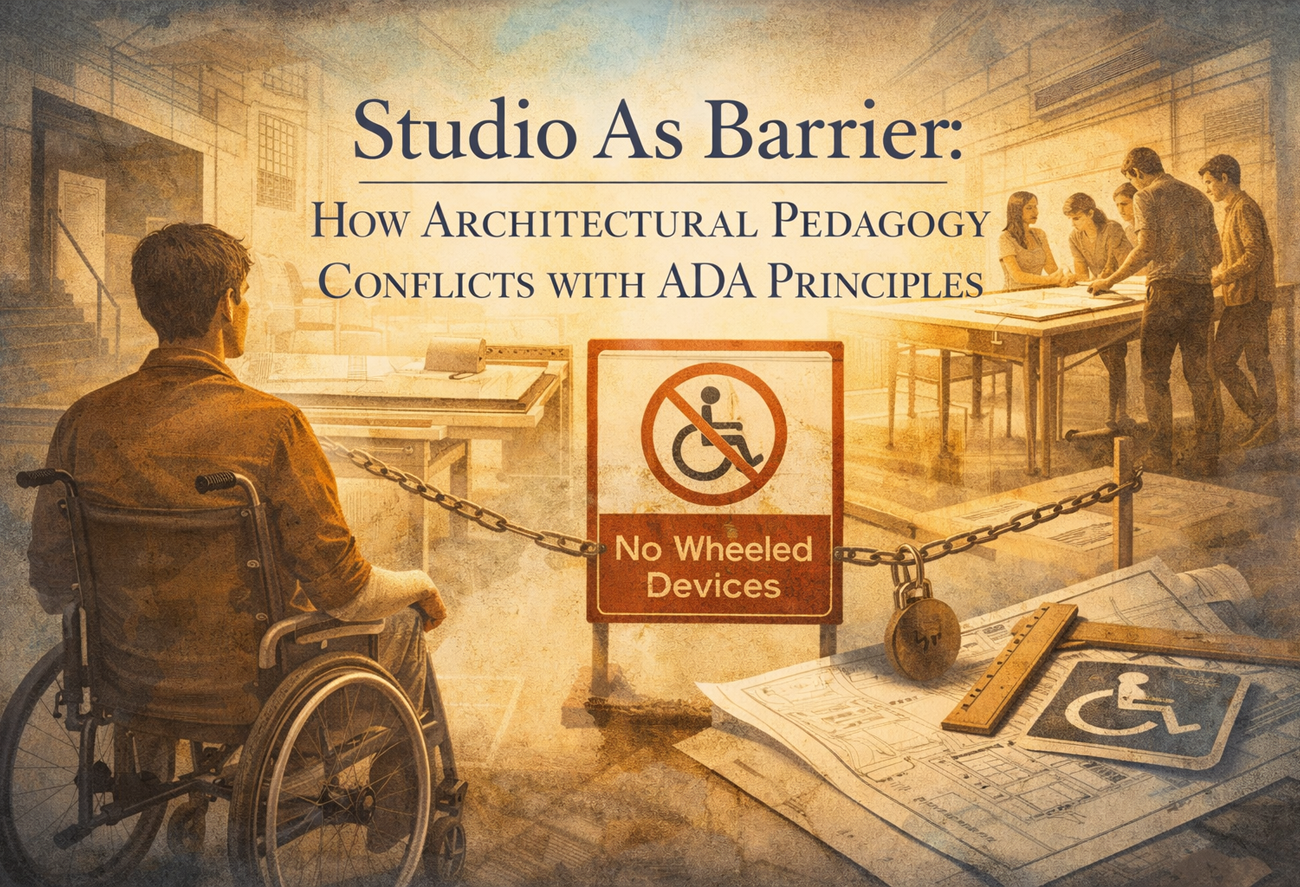
Architectural education is deeply rooted in a studio based learning model, which immerses the students in forced collaborative environments and creative atmospheres with their peers. However, this learning model has also been criticized for its approaches to education which create accessibility barriers. This two-part paper, Studio as Barrier: How Architectural Pedagogy Conflicts with ADA Principles, explores how the culture within the studio environment marginalizes neurodivergent students and fails to align with the spirit of the Americans with Disabilities Act (ADA and ADAA).
Part 1 of this paper examines the history and cultural foundations of architectural pedagogy, which traces its origins back to the 19th century with groups such as the Bauhaus leading as an example, as well as analyzing the unspoken norms which were created. Norms such as long hours, open critique formats, and competitive ambiguity; all which create systemic challenges for neurodivergent learners. Through the lens of these learners, whose conditions can range from Autism and Dyslexia to Post Traumatic Stress Disorder (PTSD) and Attention Deficit Hyperactivity Disorder (ADHD), and many more, this section explores how the studio’s environment can exclude these students who process and express themselves differently than their neurotypical peers. Often pushing them into the margins of the academic environment and in some cases out of the profession entirely.
Part 2 is a change in pace with a move away from the critique of the architectural studio to a more transformative learning environment, which enables all students to succeed. It argues that inclusion must start with the professorship, who must shift from believing that they are gatekeepers of the profession to facilitators of an accessible learning environment regardless of a student’s disability which can be both seen and unseen. By moving towards an inclusive pedagogical approach which focuses on Universal Design Learning (UDL), multi-modal feedback options, fostering psychological safety, and ensuring transparency in evaluations, professors can reshape not just the academic studio culture of architecture but also the professional studios in which many will inevitably end up in after graduation. By supporting this cultural change, educators support, not suppress, diverse cognitive styles which in turn creates a more diverse and richer profession. Ultimately, this paper calls for a cultural and structural shift in how design education is approached, prioritizing equity and access as a fundamental component of architectural excellence.
Part 1: The Studio as Barrier – Neurodiversity and Pedagogical Exclusion
Studio culture has long been a cornerstone of not just architectural education, but also architectural practice. Deeply rooted in traditions which date back to the Ecole des Beaux-Arts and was then further developed in studios such as the Bauhaus in Germany. The studio has evolved into a creative space where architectural identity is forged through competition, critiques, and collaborations designed to push new thoughts and ideas which in turn create new possibilities in the built environment [1] [2]. However, beneath the creative intensity and communal ethos lies the often unspoken expectations that individuals must adapt or risk being shunned as outsider who couldn’t “hack it” [3] [4].
These expectations become particularly problematic when viewed through the lens of the Americans with Disabilities Act (ADA), which mandates access in education and professional settings. When the structure of the studio itself privileges certain thinking and working patterns over others, it raises questions about who is being excluded and why; but it also raises the additional question of whether the exclusion is benefiting the profession at all.
Neurodivergent students are a group often unreported and marginalized in studio cultures. For a neurodivergent student a diagnosis can range from autism, ADHD, PTSD, bipolar, anxiety, depression, and many more, which in turn creates unique barriers for them within architectural studio environments [5]. These barriers are not due to a lack of skill or creative capacity but are because studios are not designed to accommodate diverse learning needs. There are unspoken expectations that a student must conform to the singular model of learning, which is a neurotypical model, provided in the profession which in turn becomes a silencer on the student that marginalizes anyone who might think, process, or engage differently than someone who is neurotypical. [6]
Compounding the issues is the romanticized notions touted by professors and alumni of the “all nighter” or “living in the studio” culture, where an individual’s success is often tied to their physical endurance, emotional resilience, and a monk type devotion to not only design but also the culture of architecture1. Placing this value so high up marginalizes students who require structured time management, reduced sensory inputs, or who might require proper sleep schedules to maintain mental health balance. And as the built environment transitions back to a more holistic approach, which increasingly features inclusive and equitable design choices, it becomes essential that the educational environment reflect those values. If architecture is teaching us that spaces shape an individual’s experience, then the design of learning environments must be no exception.
This section explores the conflict between studio culture and architectural pedagogy with the lens of a neurodivergent learner and ADA principles. It will delve into an investigation of the origins and expectations of the studio culture, the differences between learning types, and how educational models rooted in flexibility and inclusion can foster environments where all individuals are empowered to succeed.
Understanding Neurodiversity
Neurodiversity has become a catchall term which in recent years has gained increased recognition in both educational and workplace environments. Sociologist Judy Singer in the late 90s was a proponent of the term which focuses on the idea that neurological differences are just natural variations in the human condition and are not a defect which need to be “fixed” [7]. This directly challenges the traditional cultural views of cognitive disabilities, which are often viewed as impairments even today. In educational systems the shift from traditional (i.e. medical) model to social model implies that there is not just a duty to accommodate students with cognitive differences but also to be proactive in designing systems which embrace them.
For neurodivergent students they process, perceive, and express information and emotions differently than their neurotypical counterparts. This can include differences in sensory sensitivity, executive functions, communication preferences, and even social interaction styles [8]. While some view these as an indication of a lack of intelligence or capability in an educational environment, they actually reflect alternative ways in which to engage. However, educational environments are designed around students who do not have cognitive differences which creates the disadvantages that many neurodivergent students face 8.
The ADA was not just established to protect those with seen disabilities; it was also to protect those with unseen disabilities. This piece of legislations primary purpose who to protect individuals from systemic exclusion in areas such as education, public spaces, and workplaces. Under Title II, public educational institutions are required to ensure that all programs and services are accessible to everyone. Title III extends the mandate from Title II to the physical and operational aspects of these educational programs. While physical accommodations have become common place on campus’s, cognitive and sensory accessibility has remained unaddressed. The studio environment, with its sensory rich, often unpredictable, and high pressure culture is an exemplary example of the gap between legal compliance and inclusion. [9] [10]
With neurodiversity encompassing such a wide range of conditions it is important to recognize that while they may have overlapping accommodation needs, each student is still an individual and may not align completely with another student with the same condition. Individuals with autism for example may experience heightened sound sensitivity making the constant noise in a studio taxing and overwhelming. While a student with ADHD may struggle more with time management since much of the studio time is unmanaged and chaotic. And then another student with PTSD may require the ability to leave the environment completely due to overstimulation in order to feel physically safe. The needs of each of these individuals are as unique as the individual themselves, however their commonality is that they all process information and stimuli differently than their neurotypical peers. [8]
Despite there being recognition of the differences between neurodivergent and neurotypical learners, architectural education is still reactive rather than proactive. Offering accommodations on a case by case basis, only if the student identifies and goes through the disability office on their campus. This issue requires a more proactive approach, since many students do not self-identify for fear of being othered by peers and instructors. By embracing the fact that many individuals are neurodivergent, institutions can move beyond just basic compliance in order to foster genuine inclusivity and accessibility for all so that they are not just accommodated but are also seen as valuable. [6]
Neurodivergent vs Neurotypical Learning Needs
As previously discussed, studio environments are designed around the neurotypical learner model. This model presumes that all students can comfortably engage in spontaneous verbal critiques, thrive in unstructured environments, and navigate difficult workflows with little to no assistance, with a prevailing expectation that the student will either adapt or they will fail. Students then show resilience to these expectations through long hours, fast paced learning in different formats and programs, collaborative efforts, and of course the ever important public performance for critique. 1
For a neurodivergent student, however, these unwritten expectations often clash with their learning needs. Since many require structured schedules, clear and consistent communication, and predictable routines in order to succeed to their full potential. Sensory regulation is extremely important as overstimulating environments, such as ones that are noisy, bright, and crowded can quickly become overwhelming and distracting. And feedback is often more effectively received when provided in written or visual formats, allowing the individual student to process the information, reflect, and then gain valuable guidance on how to proceed.
Consider, for example, a veteran student with PTSD. This student may experience heightened sensory sensitivities to sudden sounds, crowded spaces, and unstructured environments; all of which are completely normal in contemporary studio environments. Situations such as unpredictable critiques, group projects, the constant movement of persons in space, and loud noises can trigger symptoms such as hypervigilance, anxiety, or even dissociation. Often these students find it difficult to participate fully or be physically present because the spaces provide no quiet areas and are designed for those who process surroundings differently than themselves. What is designed as an immersive experience for one individual is sometimes viewed as a threat to another. Not because the individual is weak but because their brain is processing their surroundings differently after the trauma or situations they may have encountered in the past. [11]
Autistic students differ in that they tend to be highly skilled in spatial reasoning and pattern recognition but struggle with the unpredictability of critiques, group dynamics, and can experience sensory overload from noise, constant chatter, and poor lighting. These conditions are not only not conducive to their learning needs but also can contribute to the exacerbation of symptoms associated with their diagnosis. Similarity students with dyslexia or auditory processing disorders may also be left behind their peers in the fast paced studio environment where information is often given in verbal formats while background noise creates difficulty in understanding. In each scenario the education challenges the students face stems from environments which are inflexible and unresponsive to the individual diverse needs. 5 8
The critique centered system which evaluates a students work not only throughout the semester but also as a final stage of the program poses additional challenges for neurodivergent learners. Public criticism, spontaneous questions, and often ambiguous expectations can be more difficult for students who have social processing differences or trauma histories 1. Verbal feedback can also add to difficulties for students who need additional time to process the information being given to them or those that need information to be provided visually. For some individuals, the pressure to present and perform in front of their peers can create a barrier to being able to demonstrate their approach to design thinking and even the designs progress. Often creating a disconnect between the student and the professor, adding frustration for both. In many cases, the educational environment penalizes students not for their lack of effort or intelligence but for not being able to navigate a system that was never designed for them to participate in the first place. 3 4 8
Understanding the differences between neurodiverse and neurotypical is not about attempting to lower standards or destroy the culture or historical aspects of studio environments, it is instead about expanding the ways that we define success and participation. Those with nontraditional learning needs can and do succeed when given the right tools and environments for their success. Their insights often bring new approaches to design challenges that would not have otherwise been thought of. But to support these students, institutions must first acknowledge the structural and cultural obstacles embedded within the programs.
Studio Culture: Historical Origins and Contemporary Practice
To understand why architectural studios, function the way they currently do, we must first examine the historical roots. Traditions which are embedded so deeply into the environment that it is difficult for individuals to understand where they come from. But these traditions weren’t created in a vacuum, they were constructed over centuries of pedagogical practices that prioritized discipline, hierarchy, and elite mentorship. Studio was never designed to be as diverse as it is now, with different cultures, genders, identities, disabilities, and talents all participating in a singular environment that was designed for white, wealthy men. 1 [12]
What initially began as a master-apprentice model in the Ecole des Beaux-Art in 19th century France morphed as time went on. The original system had a heavy emphasis on hierarchy, critiques, and competition among designers which was known as “esquisses”. These studio environments were specifically designed to be environments with rigorous professional initiation in which apprentices demonstrated their dedication to the practice through long arduous hours under the supervision of those who were already seen as masters in the field. The learning model was immersive, but it was exclusionary in that it did not accept women or those with disabilities. [13]
As time went on this format of studio was reimagined and adapted to fit Modernist goals in studios such as the Bauhaus in the 20th century in Germany. It offered a more radical approach to the collective and interdisciplinary nature of architectural practice and education. It’s pedagogy emphasized experimentation and collaboration, while retaining the critique drive models that came before it with public evaluation of works produced. The emphasis on open critiques, hands-on learning, and peer engagement became what is now deeply embedded in architectural education. [14]
In the post-World War II educational environments, these traditions and norms were adopted and evolved further within the United States. And as Modernism began to take hold and professional accreditation bodies started to form, the studio culture within architecture became synonymous with rigor, competition, long hours, public performance, and jury reviews. But there was also an emphasis placed on design-build projects, high stakes presentations, and the implication and expectation that students were to demonstrate their commitment through sacrificial practices, such as “living in the studio”. [15]
In more contemporary education environments, majority of these historical practices still remain today. Studios are often designed with an open floorplan concept, communal environments which force constant engagement and interaction with an individual’s peers, critique sessions which are high stakes and high pressure, and the push for “living in the studio” by some professors as a professional requirement for a grade. These are all celebrated by both faculty, students, and alumni as rite’s of passage into the profession. And while some of these traditions do foster a sort of comradery and immersion for some, they are also institutionalized norms which place privilege over inclusion. With many studio courses having unstructured timelines or due dates that crop up unexpectedly on a professors whim, sensory intense environments, and performative requirements which all stem from traditional pedagogy but do not account for inclusive mindsets or necessary flexibility in the educational environment. Without a critical analysis of these practices, they will continue to marginalize students who fall outside the “norms” expected of them. [16] [17]
The Studio Environment as an Accessibility Barrier
While ramps, elevators, and other ADA-compliant entrances and bathrooms are standard practice within the built environment; sensory and emotional accessibility is rarely accounted for and most of the time it is overlooked completely. Since these barriers are not visible to the naked eye of an observer they are often pushed aside, even when the student may have an accommodation, since the environment of architectural study is not designed for those with accommodations.
A significant workflow barrier that students face is scheduling with studio courses. Many of which have shifting deadlines, informal feedback, fluid instructional time, and the student must be available at all times throughout the instructional period which can last up to 6 hours in a single day. For a neurodivergent student who relies on clear instructions and routines, these norms can increase stress, missed assignment deadlines, and a sense of exclusion from their peers and profession. The unspoken norms such as these reward only those who can navigate the utter chaos and punishes those who require more structured settings or flexible workspaces. [18]
Another barrier faced within studio environments is that of sensory overload. Walk into an architectural, or design education, studio anywhere in the world and it’s not hard to identify where there might be an issue: loud conversations, crowded spaces full of machines and bodies, machines humming and screeching, instructional lectures overlapping with side conversations, music, and road noise mixed with fluorescent lighting which buzzes and flickers all in a space that is purported to push creativity. Those with sensory processing sensitivities, such as diagnoses of ADHD, PTSD, or even autism, this environment can be debilitating. With no space for quiet work or sensory regulation to be found, which means students are forced to either accept their surroundings or flee from them. Those that do stay operate in a state of hyper vigilance, which detracts from the work and their creative focus. [19]
Additionally emotional and psychological barriers further reinforce marginalization in the critique structures used primarily during midterm and final presentations. Public critique often involves defense of the project, but also spontaneous questioning, ambiguous and subjective feedback, and a social component which requires extroversion during the performance. Students who face anxiety disorders, or who process social interactions differently, face the challenges of critiques where the experience can be traumatic rather than constructive, often leading to feelings of inadequacy. Without an alternative method for feedback, such as private evaluation or written feedback, these types of students are left to navigate an already emotionally taxing environment alone. 1
And lastly, is the glorification of endurance within the academic environment. This is manifested through all-nighters and marathons, which promote social isolation and pure dedication to the work and individuals within the profession. This culture is normalized by professors and professionals alike where they encourage exhaustion and overworking oneself in order to show dedication and drive, while disadvantaging individuals who require regular rest periods, structured time management, or who may be managing chronic conditions. Even while the ADA mandates equitable access, the very culture in which architectural students grow up is one where the learning environment is entirely predicated on unhealthy work practices and true accessibility is difficult to attain. [20] [21]
In sum, the structural, sensory, and emotional barriers placed within studio pedagogy all create barriers to equitable access for millions of students. Addressing the barriers which have been created requires an almost fundamental change in the way that studio culture is approached, but also how pedagogies are designed. Where architectural education moves past just simple compliance and into genuine inclusivity. 21
Conclusion
Architectural studios are integral parts of architectural education and practice, they are the heart of creative exploration and creativity. Yet, beneath the collaborative and immersive engagement lies a systemic issue that unintentionally excludes students who do not process the world in the same way as others. The barriers which neurodivergent students face are often not associated with deliberate discrimination, rather they are a biproduct of long held traditions which make endurance the primary goal. The cultural norms, often which are unspoken, narrowly define a pathway of professional success which aligns only to neurotypical learners and practitioners which ultimately devalues and marginalizes those who engage, process, and contribute differently.
Although the ADA mandates equal access regardless of ability to educational programs, studio environments often remain in conflict with the spirit in which the legislation was written. The challenges that neurodivergent learners face are seen as an inconvenience in the educational environment of a studio. These challenges then create additional barriers to participation and comprise the well-being and academic success of students.
Identifying these issues is just one step in the long process in proactive awareness and inclusivity. To align fully with the spirit of ADA architectural education must critically reexamine and restructure how studios are taught so that they are inclusive and promote design equity. This means confronting and even transforming the very foundations in which the culture was born from. In Part 2, we will discuss solutions, offering strategies, pedagogical shifts, and institutional reforms which can reimage the studio environment as not a gatekeeping step in the profession, but into one that is accessible, diverse, and innovative.
References
[1] Anthony, K. H. (1991). Design juries on trial: The renaissance of the design studio. Van Nostrand Reinhold.
[2] Salama, A. M. (2015). Spatial Design Education: New Directions for Pedagogy in architecture and beyond. Routledge.
[3] Belluigi, D. Z. (n.d.). Constructions of Roles in Studio Teaching and Learning. The International Journal of Art & Design Education. https://doi.org/10.1111/jade.12042
[4] Fisher, T. (2000). In the scheme of things: Alternative thinking on the practice of Architecture. University of Minnesota Press.
[5] Brown, K. R. (2017, January 1). Accessibility and students with autism spectrum disorder: Legal perspectives in the United States (in press). Exploring the Future of Accessibility in Higher Education. https://www.academia.edu/29072502/Accessibility_and_Students_with_Autism_Spectrum_Disorder_Legal_Perspectives_in_the_United_States_In_Press_
[6] Sheryl, B. (2007, January 1). Universal Design in Education: Principles and applications. Research Gate. https://www.researchgate.net/publication/230853086_Universal_design_in_education_Principles_and_applications
[7] Botha, M., Chapman, R., Giwa Onaiwu, M., Kapp, S. K., Stannard Ashley, A., & Walker, N. (2024). The neurodiversity concept was developed collectively: An overdue correction on the origins of neurodiversity theory. Autism, 28(6), 1591–1594. https://doi.org/10.1177/13623613241237871
[8] den Houting, J. (2018). Neurodiversity: An insider’s perspective. Autism, 23(2), 271–273. https://doi.org/10.1177/1362361318820762
[9] The Americans with disabilities act. archive.ADA.gov homepage. (2008). https://archive.ada.gov/taman2.htm
[10] Americans with disabilities act title III regulations. ADA.gov. (2012). https://www.ada.gov/law-and-regs/regulations/title-iii-regulations/
[11] Elliott, M., Gonzalez, C., & Larsen, B. (2011). U.S. military veterans transition to college: Combat, PTSD, and alienation on campus. Journal of Student Affairs Research and Practice, 48(3), 279–296. https://doi.org/10.2202/1949-6605.6293
[12] Elliott, M., Gonzalez, C., & Larsen, B. (2011). U.S. military veterans transition to college: Combat, PTSD, and alienation on campus. Journal of Student Affairs Research and Practice, 48(3), 279–296. https://doi.org/10.2202/1949-6605.6293
[13] Cret, P. P. (1941). The Ecole des Beaux-Arts and Architectural Education. Journal of the American Society of Architectural Historians, 1(2), 3–15. https://doi.org/10.2307/901128
[14] Wick, R. K. (2000). Teaching at the Bauhaus. Ostfildern-Ruit : Hatje Cantz.
[15] Mayo, J. M. (1992). Architecture: The story of practice. Journal of Architectural Education, 46(1), 61–62. https://doi.org/10.1080/10464883.1992.10734537
[16] Pasenidou, F. (2024). The emerging intersection: The role of architecture in promoting Inclusive Education. Oxford Review of Education, 1–17. https://doi.org/10.1080/03054985.2024.2427041
[17] Dutton, T. A. (1987). Design and studio pedagogy. Journal of Architectural Education, 41(1), 16–25. https://doi.org/10.1080/10464883.1987.10758461
[18] Ahrentzen, S., & Anthony, K. H. (1993). Sex, stars, and studios: A look at gendered educational practices in architecture. Journal of Architectural Education, 47(1), 11–29. https://doi.org/10.1080/10464883.1993.10734570
[19] Tyre, M. (2024, September 20). Creating new classroom spaces for neurodivergent students (opinion). Inside Higher Ed | Higher Education News, Events and Jobs. https://www.insidehighered.com/opinion/career-advice/teaching/2024/09/20/creating-new-classroom-spaces-neurodivergent-students
[20] Dutton, T. A. (1987). Design and studio pedagogy. Journal of Architectural Education, 41(1), 16–25. https://doi.org/10.1080/10464883.1987.10758461
[21] Salama, A. M., & Wilkinson, N. (2007). Design Studio Pedagogy: Horizons for the Future. The Urban International Press.
No Comments
Sorry, the comment form is closed at this time.