




Review: Burns & Kahn: Why Site Matters
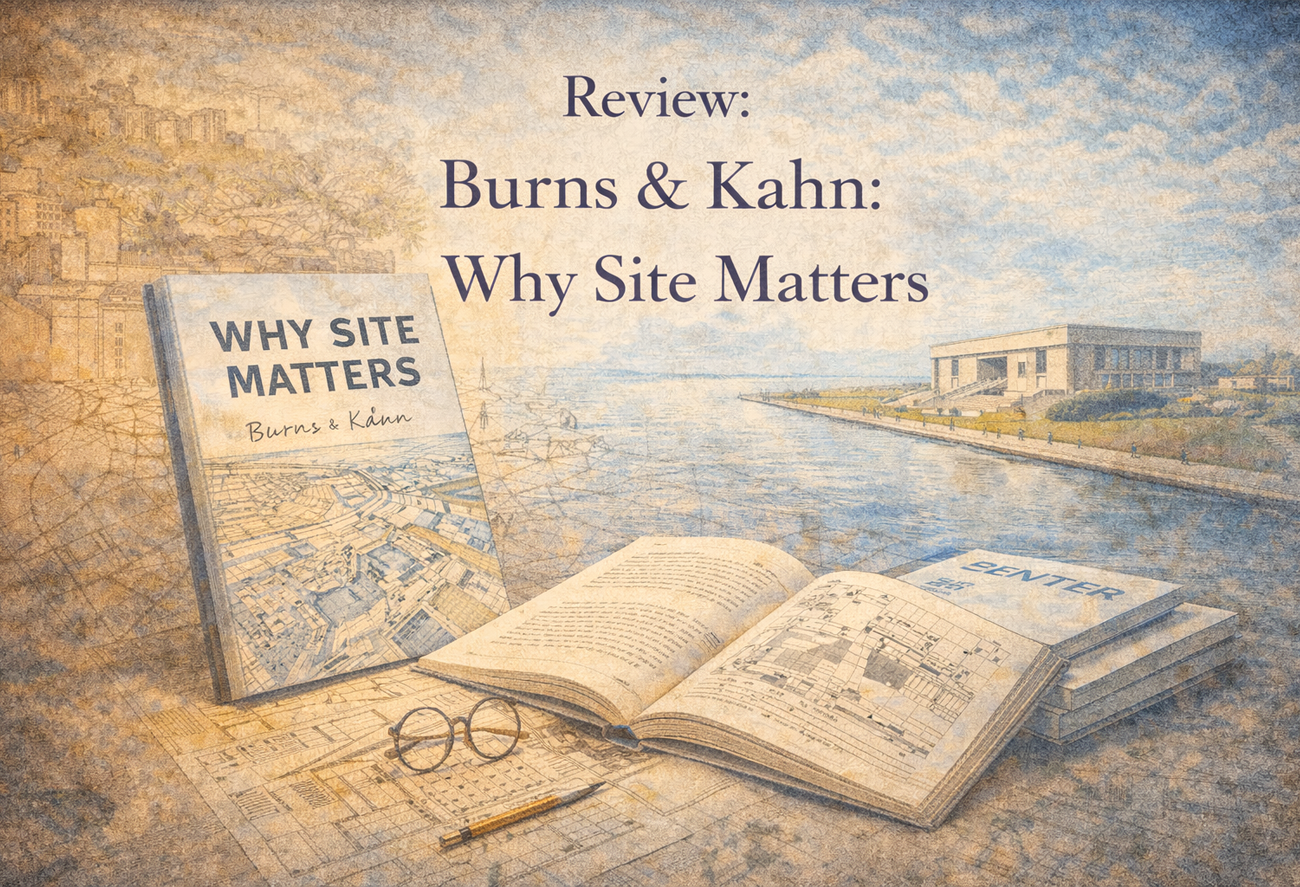
In “Why Site Matters”, Burns and Kahn dismantle a long-standing assumption that a site is bound to parcels of land which are assigned to a particular project. Instead, the thought is that the site is a relational field; shaped by history, politics, ecology, and human perceptions. The reading begins by illustrating how different architects faced with the same Olympic Village site constructed entirely different models of what the “site” even was. Some emphasized edges and topography, others engaged with history, and still others expanded the site outward into the surrounding city. These examples are the basis for a deeper argument: that site is never singular, never neutral, and never purely physical. As the authors write, “Site and designer engage in dialogic interaction,” (pg. xv) a sentence that reveals that the site is not just passive ground which we build upon, but that it is an active participant in design thinking, in shaping intention, meaning, and forms.
The authors expand the notion of site beyond property lines by identifying three areas which they see as being related: the area of control, the legally defined plot; the area of influence, the larger systems (ecological, economic, cultural) that act upon it; and the area of effect, the extended reach of design consequences. The reading insists that design must acknowledge forces both visible and invisible which produce place. To design is not simply to manipulate form but to enter into a conversation with conditions which already exist.
What emerges is a powerful critique of design disciplines themselves. Architecture, landscape architecture, and planning each inherit internal habits within their professions; they have their own vocabularies and/or assumptions which can often obscure more than they reveal, especially to lay people. Representational tools can be clarifying but also create limitations. An example would be a map which stops at the property line and erases the watersheds, wind patterns, political histories, and social struggles that continue across the page into the unseen corners. They almost seem to insist that site knowledge is always situated, and is shaped through discourse, tools, physical experience, and cultural frameworks.
In reading this, I find myself returning to a few fundamental questions: If site is a relational construct, why do architectural studios present it as fixed? Why do our pedagogical models still treat site as neutral terrain rather than as the product of power, memory, ecology, and human complexity? The text is almost pushing me to confront how often design education and practice reduce site to technical data rather than to acknowledge the intricate relationships which create it and what surrounds it.
For my own work, which is rooted in underserved and rural communities, rural landscapes, and the histories which shaped those communities, this reading resonates with me. It affirms my belief that the site is layered with stories, traumas, hopes, and systems, and that ignoring these layers leads to shallow designs which have little to no soul in them. I locate myself firmly in the position that site cannot be understood solely through surveys and boundary lines. Instead, site must be read through lived experiences, through history, through the subtle exchanges between the seen and unseen world.
No Comments
Sorry, the comment form is closed at this time.